Would You Watch Someone Die?
The U.S. may livestream Nidal Hasan’s execution by firing squad. What happens when state violence becomes transparent, permanent, and consumable online?

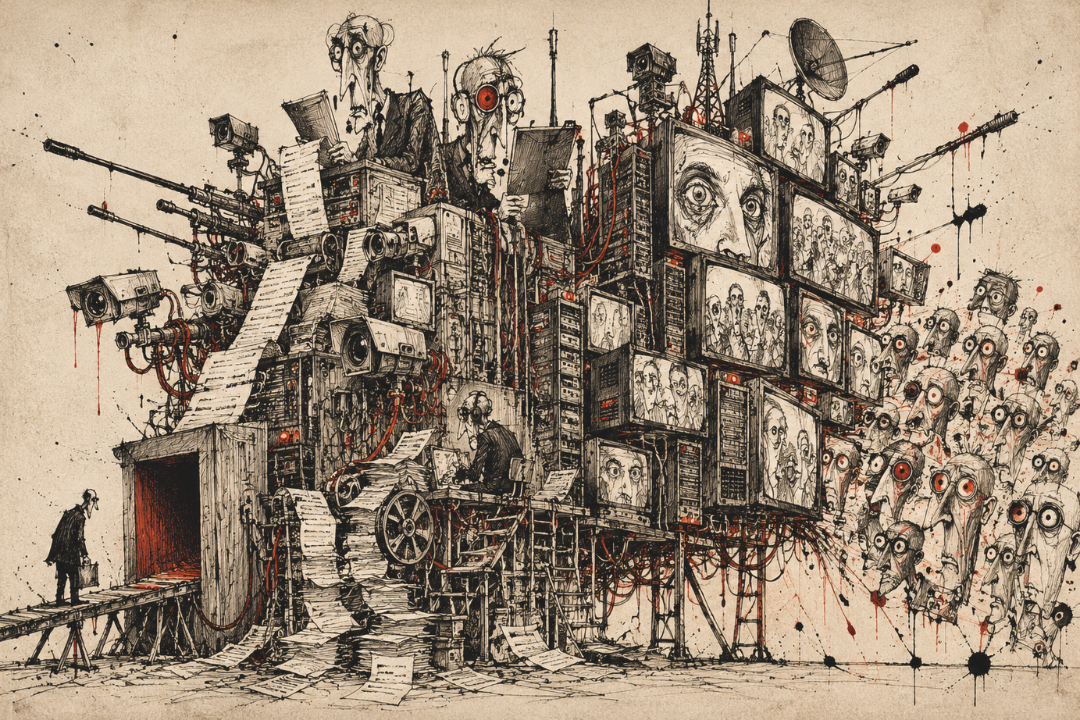
The United States government, American citizens, and now the entire internet are currently debating whether to livestream a man being shot to death. Yes, in 2026.
And I’m painfully aware that there are enough strange nouns packed into that sentence that it takes a not-so-brief moment to process it in totality.
Government. Livestream. Firing squad. You can almost hear some unfortunate, sweaty civil servant asking whether the execution feed needs closed captions and a content warning.
That sentence feels like it should have emerged from a particularly unimaginative dystopian novel, but yay, here we are!
On December 3, former Army psychiatrist Nidal Hasan is scheduled to be executed by firing squad for murdering 13 people and wounding 32 others at Fort Hood in 2009.
The Pentagon has since announced plans to livestream that execution.
Donald Trump initially said he approved, then walked back that approval by expressing doubts about broadcasting it.
Vice President JD Vance supports Hasan facing justice but said he would not watch. Defense Secretary Pete Hegseth has argued that people need to understand there are serious consequences for acts like Hasan's.
Source: The Guardian
Congratulations, you are here to witness the fact that we have apparently reached the point where the United States has to develop a content strategy for the firing squad.
If this does indeed go forward, Reuters reports that it would apparently be the first known lawful execution ever livestreamed or broadcast to the general public.
So. Three questions have been endlessly needling at me since this story broke:
- Should Hasan be executed?
- If the state executes him, should the public be allowed to witness it?
- And does livestreaming create transparency, or does the technology transform an execution into something else entirely?
Source: Jesse Welles
I only have a confident answer to one related question.
Would I watch?
No.
I Don't Want to See It
I am aware that an enormous, dark, and deranged subterranean internet exists for the gremlins and goblins who willingly descend into this sort of thing.
War footage, cartel murders, executions, terrorist videos, suicides, industrial accidents, people getting hit by trains, and practically every other horrible configuration in which a human body can stop being alive is available somewhere on the internet or its darker, seedier counterparts.
I do understand the morbid curiosity. I remember being a kid during the early internet and hearing murmurs at school about forbidden videos that under no circumstances should ever be watched, which of course guaranteed that someone had watched them and would describe the contents in complete and horrific detail over school lunch.
Death is, after all, the one appointment every human being will eventually keep...
The single common denominator we cannot optimize, outsource, or pay a consultant to remove from the roadmap, despite the extraordinary effort modern civilization has put into pretending otherwise.
Most of us spend an entire lifetime knowing exactly how the story ends while avoiding almost every firsthand demonstration of what the ending will actually look like.
Still, I have never had much desire to go looking. I simply ain't got the intestinal fortitude or the will.
Whatever primitive curiosity exists in me about the precise instant when a living person becomes a dead one is overwhelmed by the knowledge that, once seen, no amount of head or eye bleach can scrub that image from my partially traumatized coconut.
The internet has already deposited enough garbage up in there. I do not need to voluntarily install an execution on top of that mess.
That reaction would make this thought piece much easier to write if I were equally certain that Hasan should not be executed. Unfortunately, I am not.
This is an unusually brutal case for comfortable moral theorizing. Hasan murdered 13 people and attempted to murder dozens more. There is no need to rehabilitate him into some misunderstood victim of circumstance for the argument to become difficult.
What he did was, without a doubt, abominable.
This is where my brain and heart begin throwing furniture at one another.
I can intellectually understand the argument that some crimes are so horrific that the person responsible has forfeited the right to continue living. Then the abstract phrase “death penalty” has to become a physical event involving a living body.
A living human being is restrained while several others are handed rifles and given an order. Fingers twitch a fraction of an inch, bullets cross the yard, and a consciousness that existed a second earlier is completely removed from our plane of existence.
My philosophical certainty tends to deteriorate somewhere in that sequence.
And I am lucky. Nobody has appointed me Caesar, judge, executioner, or member of the military firing squad at Fort Leavenworth in Kansas. It won't be me who has to decide whether Nidal Hasan deserves another sunrise.
Palmer Luckey, however, has introduced a much more irritating question.
What if my ability to remain comfortably undecided depends partly on never having to look?
The Comfort of Not Looking
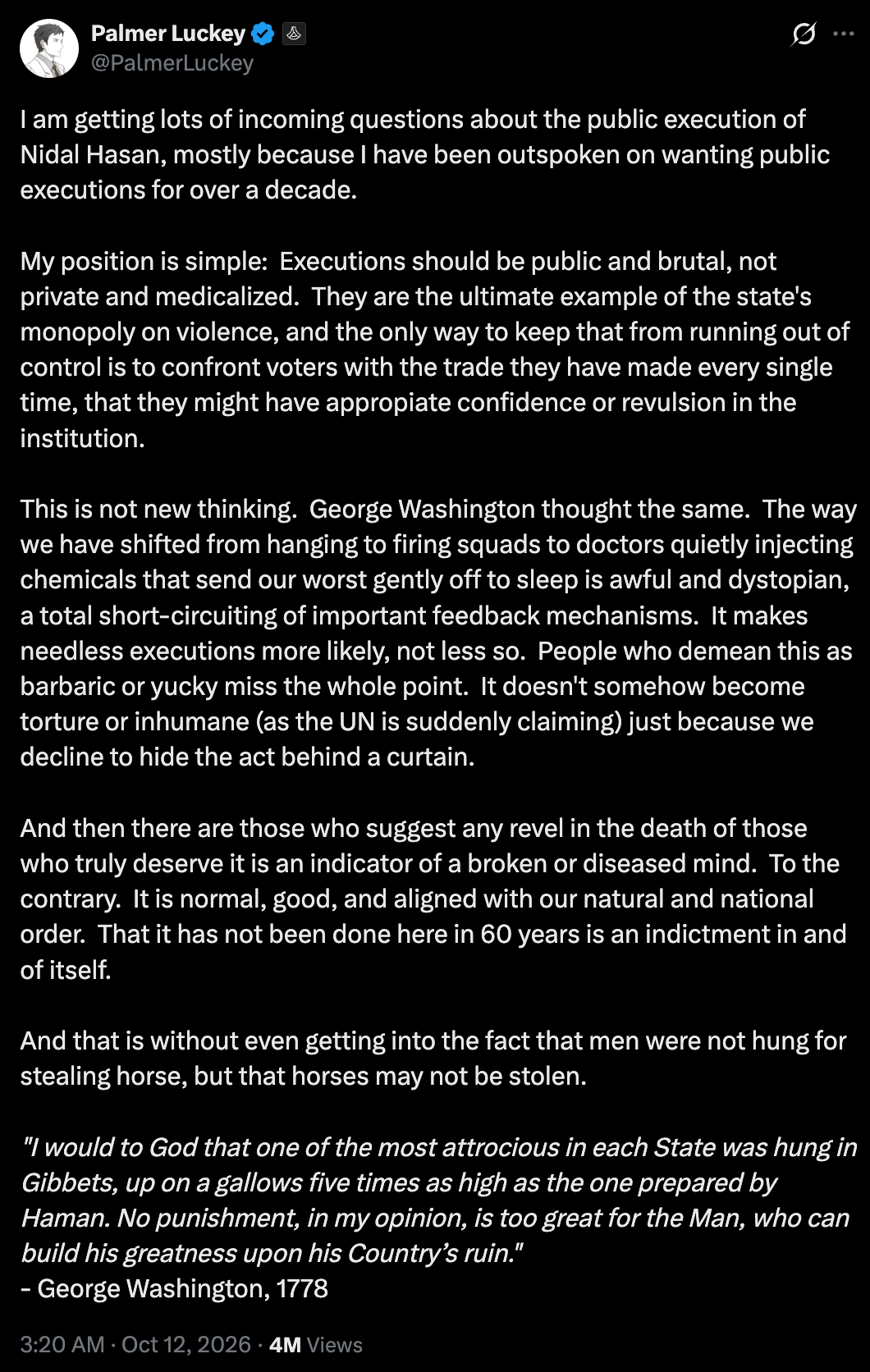
Luckey, the founder of Anduril, came out in favor of public executions and argued that they should be brutal rather than hidden behind a medicalized procedure.
His broader point is that if the state is going to exercise the most extreme power it possesses, citizens should confront the reality of that power instead of being protected from it by euphemism and four prison walls.
Executions should be public and brutal, not private and medicalized.
I dislike how much sense part of this makes.
Modern, civilized society has become exceptionally good at separating an action from its physical consequences. We have spent centuries building cleaner interfaces between ourselves and whatever ugly machinery sits underneath them.
Consider meat.
There is a familiar argument that anyone who eats animals should have to kill and butcher one at least once, a sort of License to Consume before gaining unrestricted access to the steak aisle.
I suspect the exercise would produce radically different results. One person might kill the chicken, pluck it, clean it, roast the thing with rosemary and sleep perfectly well that evening. Another would get halfway through the process and discover an urgent lifelong passion for chickpeas and tofu.
The moral ranking of the two diners doesn't really matter to me.
A steak appears in the supermarket clean, rectangular and wrapped in sterile plastic. Nothing about the transaction requires its buyer to contemplate eyes, blood, screaming, organs, fear, a knife, or the long and unpleasant sequence of events that transformed an animal into a $14.99 object under fluorescent lighting.
So we can establish that distance makes participation easier.
We perform this same lil' magic trick elsewhere too:
- War becomes arrows moving across maps.
- Pollution becomes tons of carbon buried in some nerd's Excel spreadsheet.
- Factory labor becomes unit cost.
- A drone strike becomes grainy footage of a building on a screen and, somewhere far away, a button.
I've already written about how we are using AI to remove ourselves almost entirely from the equation when it comes to warfare. The machinery gets more sophisticated, the interfaces cleaner, the human consequence further away.
Execution has received much of the same administrative treatment.
There are procedures, forms, appeals, witness lists, medical protocols, clocks, curtains, quirky rituals and official statements. The condemned disappears into a facility. At some appointed hour, the machinery of the state operates. It actually just gave me chills just now typing that last sentence.
Later, somebody announces that the sentence has been carried out.
Or, in the case of Christa Pike and her recent failed lethal injection, not carried out.
Even “carried out” is brilliant PR.
A government spokesperson never walks to a podium and announces that the state killed a human being at 8:43 p.m. The sentence was carried out, language scrubbed and polished and clean enough to eat off of.
There are good reasons for some of this. Death does not become more dignified because the government gives it the production values of WrestleMania or UFC 250, and restraint around a person's final moments is probably one of the better instincts civilization has developed.
But all that sterility also protects the rest of us from having to reconcile our political and moral positions with what those positions physically require. Somewhere behind the protocols, euphemisms, and legal documents is the hideous final mechanism that takes the life of another human being, at the behest of an institution that is itself operated by other perfectly imperfect, flawed human beings.
If I am willing to contemplate the possibility that Hasan should be executed, why should I simultaneously expect the government to spare me the sight of execution?
The Picnic at the Gallows
Public execution is hardly an innovation from the great minds of the streaming economy.
For almost our entire brutal history, the audience was part of the machinery. Executions functioned as punishment, warning, political communication, religious ritual, and public theater bundled into one grotesquely convenient package.
The Romans understood this with their usual lack of subtlety. Medieval Europe understood it. America understood it too.
In August 1936, as many as 20,000 people gathered in Owensboro, Kentucky, to watch Rainey Bethea hanged.
I personally don't understand what compels anyone to want to watch something like that.
Newspapers described a carnival-like atmosphere around the execution, including spectators eating and children picnicking while they waited. Kentucky abolished hanging less than two years later, and Bethea's death became associated with the end of America's era of public executions.
The most unsettling part of that story, at least to me, isn't the gallows. It's the picnic, the food, and the festivities mixed in with waiting for somebody to have his neck snapped. Oh and the impressive turnout.
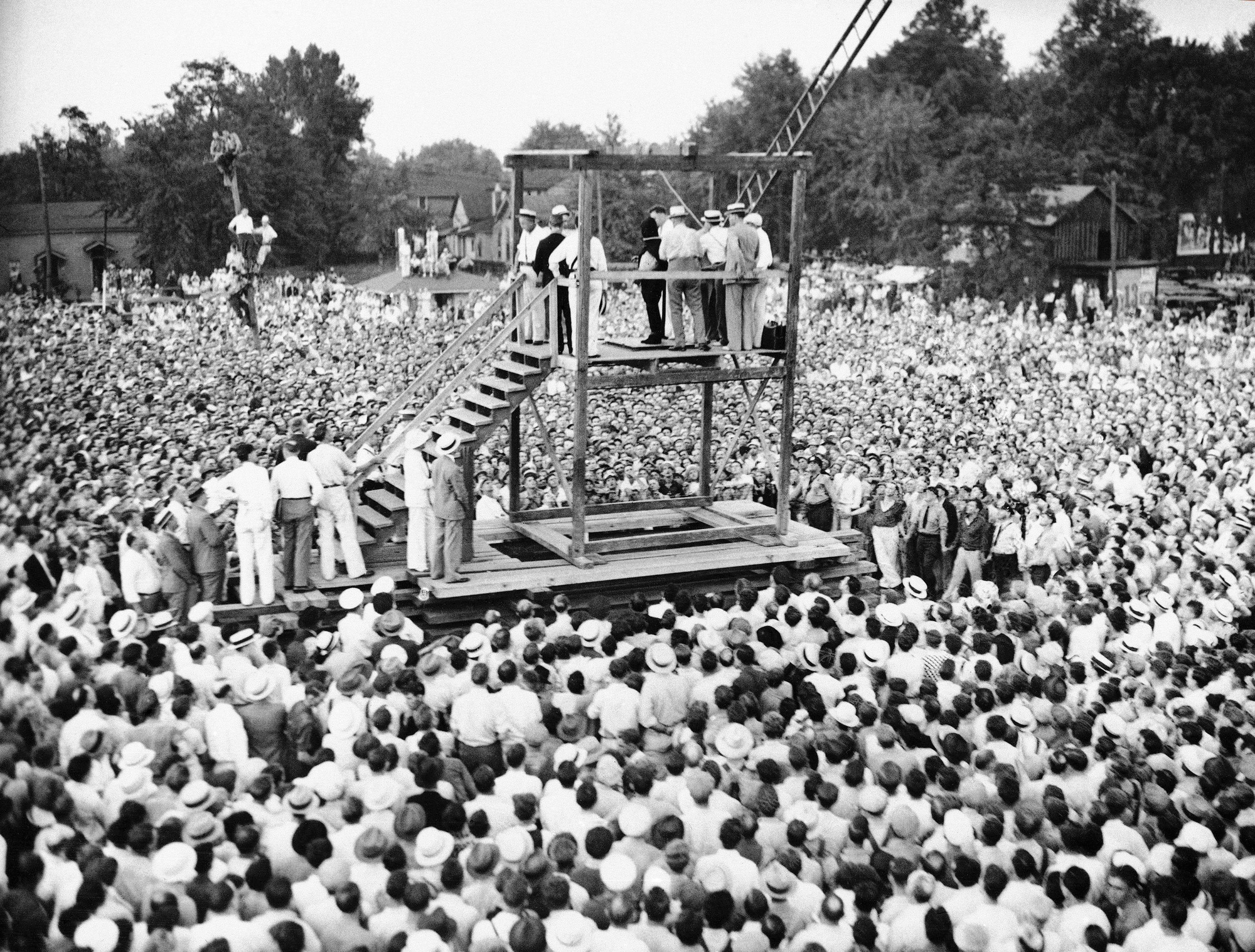
Thousands of ordinary people woke up that morning and decided this was somewhere they wanted to be. They got dressed, traveled from far and wide, competed for a decent view, and settled in for the day's proceedings.
Plenty of people probably believed they were witnessing justice. History itself would have been enough to attract others, and plain old morbid curiosity surely filled a few more rows. Human beings don’t exactly arrive at a spectacle carrying pure motives, and I sincerely doubt Owensboro was any exception to the rule.
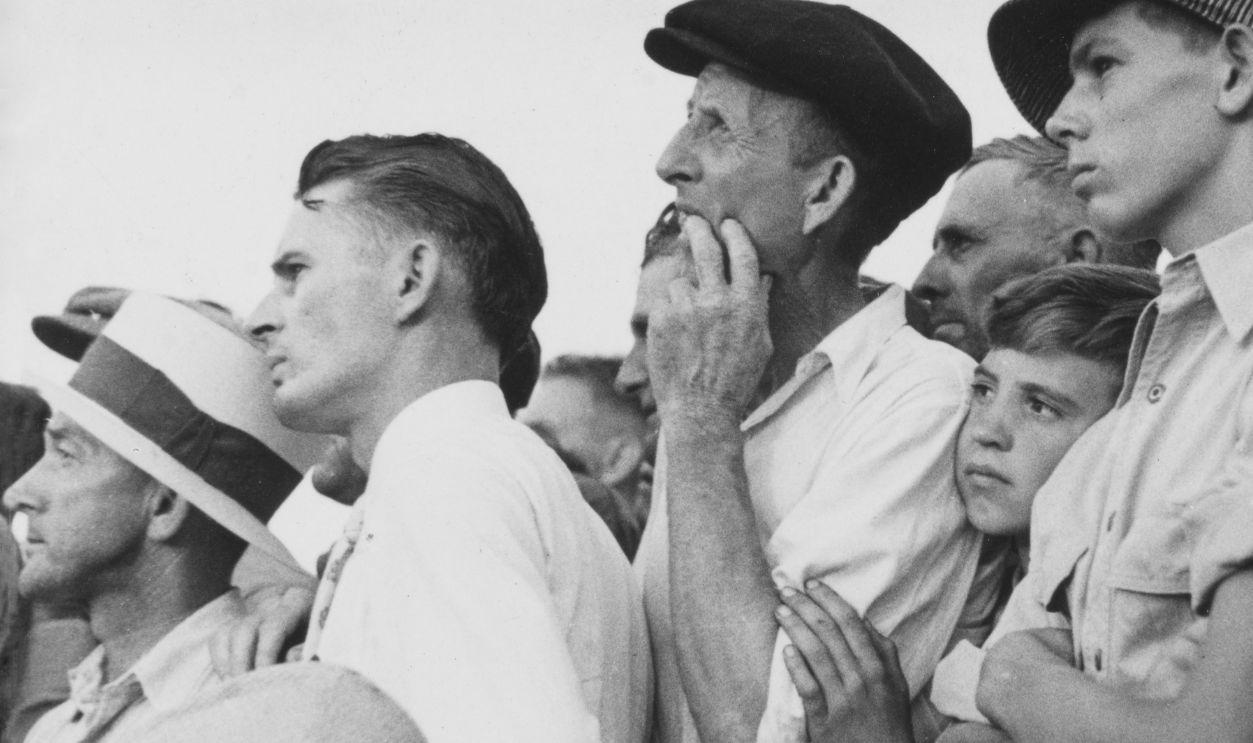
The audience changes the moral character of the event. A punishment performed in front of spectators becomes something more than punishment, even if the person on the gallows ends up just as dead.
America eventually moved executions behind walls, partly because public death had acquired that unwanted atmosphere of spectacle. There was something unequivocally uncivilized about taking the family to watch a hanging and grabbing refreshments along the way.
Unfortunately, civilization has a talent for solving one problem by manufacturing another.
Once the curtain closes, the government gains enormous control over what everybody outside it is permitted to know.
When Privacy Becomes Secrecy
None of this is an argument for turning an execution into entertainment. The idea absolutely repulses me by the way.
I am also deeply uncomfortable with the idea of the state killing people in rooms where the state controls nearly every account of what happened.
Hell, I'm not entirely comfortable with "the state" taking anyone's life in the first place, but this isn't the place to get into that right now.
Journalists and independent observers need access precisely because the government should not be left alone to grade its own homework after going ahead and ending somebody.
Procedures should be documented, and the failures, they should be completely visible.
When an execution goes wrong, as it did with Christa Pike whom I mentioned above, the public deserves something more substantial than a carefully worded statement from the institution responsible for carrying it out.
The government's most irreversible exercise of power deserves an impressive amount of scrutiny and transparency. Agruably more than anything else the government does.
Sometimes we need our faces shoved into the hideous truth before we understand the gravity of what we have been discussing.
A person can support capital punishment comfortably from behind a headline, a courtroom summary, or a polling question.
Watching an execution certainly removes some of that insulation. One viewer could leave convinced that justice had been served; another could discover that their certainty depended on never seeing the policy acquire a body, blood, and a final breath.
Either way, abstraction has lost some of its convenient cushioning.
And this I believe is the strongest possible argument I can possibly muster for showing the execution.
Once we take that argument and plug it into the internet, it gets way stranger and a hell of a lot more complicated.
Ancient Rome Did Not Have a Share Button
“Why is this guy ranting about capital punishment in a tech blog?!”
There’s a point to this, I promise.
Calling what is supposed to happen on December 3rd a "public execution" completely undersells what technology is doing and will do to the concept.
A public execution once required the public to actually be in attendence, which among other inconveniences, meant leaving the confines of one's cozy house.
The 20,000 people in Owensboro had to physically travel from all over to get there. They had to stand among other execution afficiandos, experience the weather, hear the crowd, smell whatever people were cooking nearby, stare at the haunting gallows, and essentially witness an alive person turning into an unalive one.
Even Rome had this limitation. The Colosseum was certainly depraved, but it had its walls. There were only so many seats, and when the killing stopped, everyone eventually had to get up and return home.
A livestream has no such etiquette.
I can imagine myself sitting at brunch eating toast when my phone sends me an alert: The United States government is about to execute Nidal Hasan. A tap or two collapses the distance between my breakfast table and a firing squad thousands of miles away.
Nothing else about my immediate environment changes, but that combination of intimacy and detachment is genuinely new, and even more bizarre.
And then there is what happens after the rifles erupt.
The execution itself might last a few measly seconds. But the media object created by the execution has no natural endpoint.
Someone records it before the body is removed. Another person isolates the instant the bullets hit. Clips appear. Slow-motion versions eventually follow. Don’t even get me started on what happens once generative AI is introduced into this barbaric mix.
The footage becomes evidence, propaganda, documentary material, political messaging, historical archive, and gore-site contraband, depending entirely on whose hands it falls into. And make no mistake about it: it’ll fall in everyone’s hands after all is said and done.
At some point there will almost certainly be a human face in a little box reacting to it, because the internet has apparently concluded that no event in the human experience is complete until somebody with a ring light grimaces beside it and gives their unnecessary two cents.
The best/worst part about all this? The Pentagon does not need to intend any of this. Once the footage exists, intention loses custody, and this becomes fully public and forever watchable. Permanently seared into our collective consciousness.
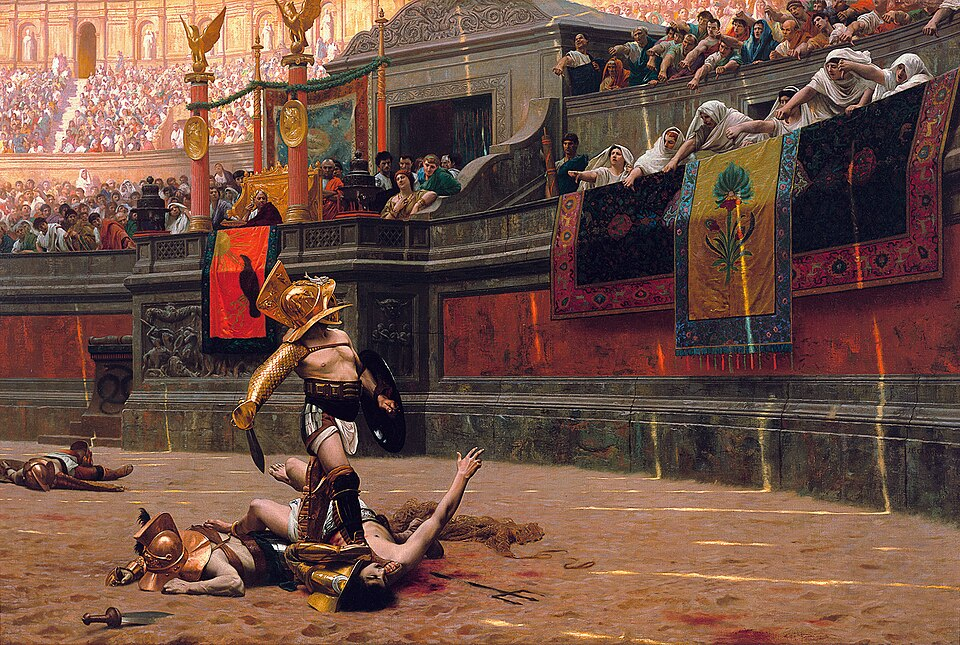
Those brutal executions in Rome ended as soon as the bloodsoaked arena emptied, much as the hanging in Owensboro ended when the crowd dispersed.
A livestreamed execution can spend the next fifty years refusing to die. Maybe more.
That is what technology changes here. Scale, permanence, geography, and the psychological cost of attendance all collapse at once. Humanity has found a way to recreate the ancient amphitheater without forcing the spectators to sit next to each other, smell each other, acknowledge each other, or even put on pants.
Community Guidelines for a Firing Squad
The situation gets even stranger when you remember that this infinite amphitheater has landlords.
Some platforms have already stated they will not participate in this spectacle. TikTok has already said it would prohibit the execution livestream and clips of it. Newsmax says it will not broadcast it.
Meta and YouTube declined to say how they would handle the footage when Axios asked them, and the Pentagon has not said where this thing would even be streamed.
Imagine having to sort that mess out…
“Does this state-sanctioned, livestreamed execution violate our community guidelines?”
That’s a real question some of the world’s biggest tech platforms are faced with right now.
Reality in 2026 continues to make satire feel underfunded. Poor comedy writers...
Platforms have spent years trying to prevent execution videos, terrorist propaganda, and footage of real killings from spreading unchecked. Reuters notes that governments and internet companies have generally moved toward restricting access to this material, partly because extremist groups have repeatedly turned executions into propaganda.
Yet the logic becomes almost comically tangled when the entity producing the footage is one of the most powerful governments on the planet.
This leaves the platforms in a pretty bizarre position.
Blocking the footage means private companies can prevent citizens from seeing an act their own government has deliberately made public. Allowing it, on the other hand, means accepting that the official feed will be copied, stripped from its original context, and ricochet through accounts whose relationship to civic accountability is, shall we say, speculative.
For all our talk about the internet and platforms like Twitter acting as a digital town square, the metaphor starts falling apart here. A town square has geography, social norms, and people standing around who can see one another. The internet gives us distribution without most of those restraints.
One View
Why did you watch?
A journalist may watch because documenting state violence is part of the job; a historian might regard the first lawful execution livestream as a primary record worth keeping; a staunch supporter of capital punishment could feel obligated to confront what the policy entails; a victim's relative may have reasons that outsiders have no right to interrogate. There will certainly and sadly,be some folks that simply enjoy watching people die.
The server receives this complicated range of human motives and performs an act of astonishing moral compression.
1 view = 1 view
There is no box beside the video labeled:
"I am here reluctantly because I believe democratic accountability requires bearing witness."
The analytics dashboard just sees a homogeneous, anonymous audience.
The word transparency is starting to do a whole lot of heavy lifting.
Transparency obviously requires witnesses and evidence. What it does not obviously require is a global audience watching a man die in real time.
A livestream can provide witnesses and evidence, but it also introduces something else: spectatorship at a scale no execution audience has ever possessed. And for good reason.
Witness and spectator can occupy the same audience, and the act of clicking tells us very little about which one we are dealing with. That ambiguity existed at the gallows too. The internet simply gives it a scale and permanence the picnic crowd in Kentucky could never possess.
Am I Just Being a Coward?
There is still an accusation underneath all of this that I cannot completely dismiss: refusing to watch could just be moral outsourcing.
I get to entertain the possibility that capital punishment is justified while judges decide, guards prepare the prisoner, the firing squad pulls the triggers, and a doctor confirms death.
Others handle the revolting physical reality while I avert my eyes and preserve the luxury of uncertainty.
There are limits to the argument, though. We do not normally require people to consume graphic evidence of every consequence attached to a position they hold. I can believe defensive war is sometimes necessary without watching soldiers bleed to death. I can accept that police may occasionally need lethal force without spending my evenings scrolling through body-camera footage.
Execution though, contains one difference that keeps gnawing at me…
Death in war can be a consequence, while death in an execution is the objective. If Hasan survives the firing squad, the procedure has failed. The violence is not incidental to the policy. It is the policy, which makes Luckey's demand that we look considerably harder to dismiss.
Three Questions, Again
So I end up back where I started, with three questions that have become less tidy the longer I've leered at them.
1) Should Nidal Hasan be executed?
I don't know.
What Hasan did was evil, and I understand why somebody could look at thirteen murdered people and conclude that no punishment short of death is proportionate.
I also understand the arguments on the other side: state fallibility, wrongful convictions, the enormous power involved in deliberately taking a captive human life, and the impossibility of undoing the decision once it has been carried out, no matter what.
My brain continues arguing with my heart. Neither has managed a knockout punch, and neither likely ever will on this matter.
All I can say on this is that I remain enormously grateful that Hasan's fate is not mine to decide.
2) If the state does execute him, should the public be able to witness and scrutinize what happens?
Yes.
The government should not be permitted to exercise its most extreme power and then disappear behind a curtain inside a prison with nothing but an official statement emerging from the other side. Journalists, independent observers, documentation and accountability matter precisely because killing is irreversible, and messy, and heavy.
Distance can make our beliefs easier to carry than their consequences deserve.
3) Does that mean the government should livestream a man's death to the entire internet?
Here I end up back in the mucky, swampy, thick of it.
Livestreaming this could force Americans to confront what capital punishment actually means. It could strip away the sanitized euphemisms and clinical furniture that allow execution to exist as a sterile political abstraction. For one person, watching confirms the sentence. For another, all that certainty goes to hell the moment the policy starts bleeding.
There is moral value in forcing an abstraction to show its face.
The internet complicates that virtue because it does more than reveal reality. Once footage enters the system, it gets copied, distributed, stripped of context, measured for engagement, transformed into memes and GIFs, and kept shambling around long after the original moment has passed.
For the first time, a state execution could combine the intimacy of witnessing a death with the reach of global mass media and the emotional distance of scrolling past something on a phone.
Neither the sterile lethal-injection chamber nor the gaudy pomp of a Roman arena really prepared any of us for that.
Rome packed people into an arena and made damn sure everyone knew they were there.
The livestream somehow manages to place the violence everywhere while allowing every spectator to remain somewhere else if you catch my drift.
I suspect civilization needs to hold two uncomfortable instincts at the same time...
We should resist systems that make the ugly consequences of our decisions invisible.
AND/BUT/ALSO:
We should also retain enough restraint to recognize when bearing witness has mutated into consumption.
Technology has made the first task easier than at any point in human history. That’s a fact.
So too has it made the second one considerably harder.
If a red LIVE badge appears beside Nidal Hasan's name on December 3, you won’t find me clicking on it. In fact, I still hold some hope that they’ll nix the whole thing outright before it happens.
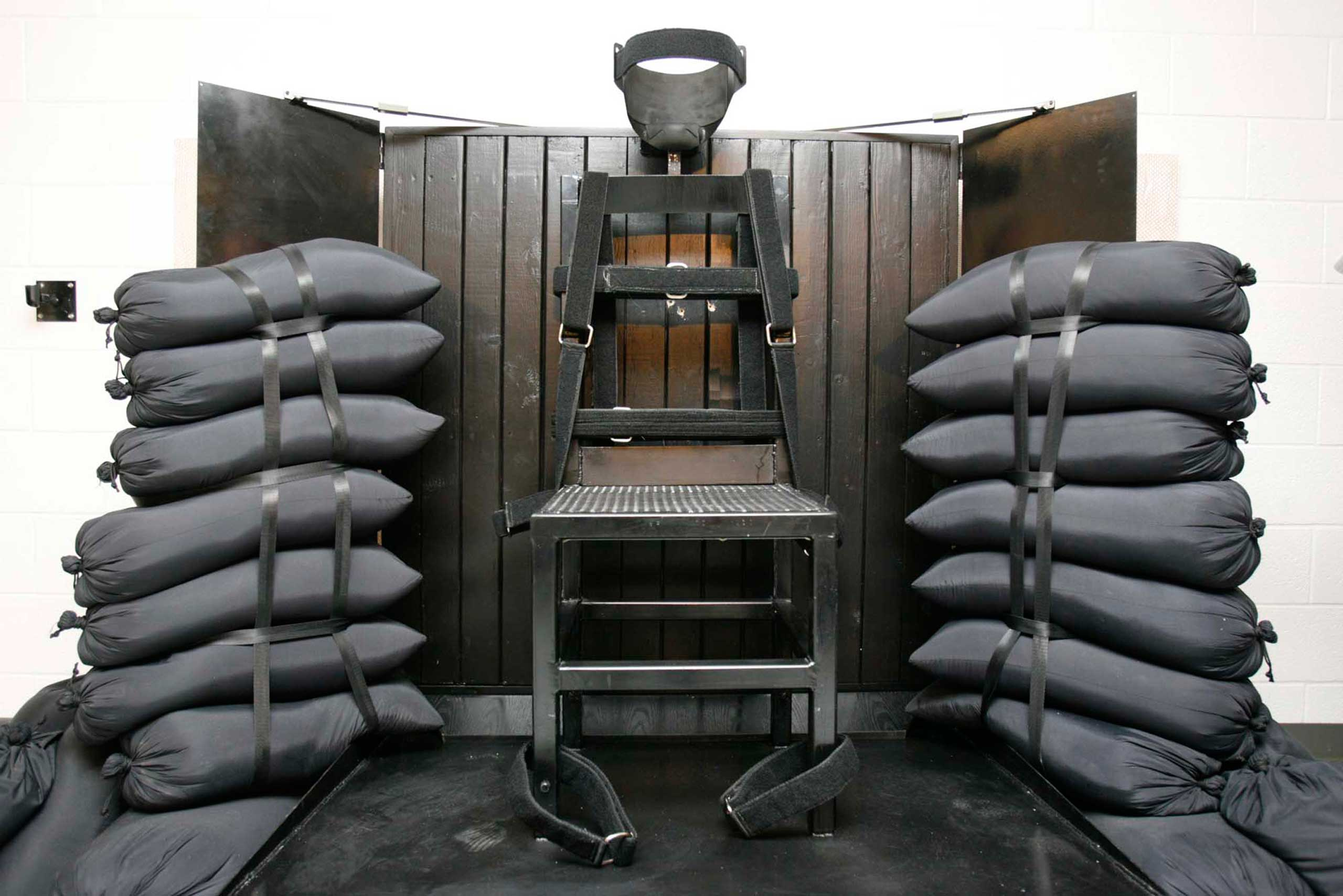
In Owensboro, twenty thousand people had to physically gather beneath a gallows. Whatever brought them there, nobody could pretend they were not part of a crowd.
We have improved the technology a whole hell of a lot since 1936.
The next crowd could number in the tens of millions, scattered across continents, sitting alone in bedrooms and offices and airport lounges, each spectator experiencing the execution as a private encounter between themselves and a screen.
The condemned will die once. The footage won't. It can be copied, clipped, and passed around for decades, accruing views long after everyone involved in the execution is gone.
That may be the strangest innovation here. We have found a way to attend an execution without ever having to admit that we joined the crowd.
No gallows to gather around. No picnic to pack. No stranger standing beside you.
Just a red button...
WATCH LIVE.