The ROI of Staring at a Wall
Twenty minutes. No phone, no music, no work. I tried meditating for two weeks and accidentally turned doing nothing into another performance metric.


I tried meditating for two weeks and discovered that I couldn't even do nothing without wondering whether it was productive.
I Failed at Doing Nothing Almost Immediately
The experiment seemed insultingly simple.
For two weeks, I would spend an unremarkable twenty minutes a day doing absolutely nothing.
No phone calls or techbro podcasts or listening to my favorite tunes.
Most definitely no computer or phone screens, or gaming, or attempting to sneak a peek at my endless onslaught of messages in every possible place and platform.
Just twenty minutes, a cushion on the floor, and the milk-white, popcorn-textured wall in my bedroom.
I wanted to see if I was still in control, piloting the spaceship of my own mind. I technically have been diagnosed with ADHD after all, but I’ve since begun to suspect that either nobody or everybody has this nowadays.
So I scooched the makeshift meditation pillow into position, switched on the fan, set an alarm, and christened this bleak little corner of the room my newly annexed meditation chamber.
Then I began staring at the wall.
Within minutes, my mind was racing. I was thinking about raising a fund. Then podcast guests I needed to book in September. My in-laws coming to visit. Laundry. Garbage day. Dinner.
Various half-baked article ideas. I even started mentally writing the article about meditation while I was supposed to be meditating.
My phone sat slightly out of reach. I kept leering at it, constantly tempted.
Not because I desperately needed to read a message or see what was happening in the world. I mostly wanted to know what time it was, and how much time had passed…
Surely I had been sitting there for fifteen minutes by now.
Not even close.
Twenty minutes turned out to contain considerably more minutes than I remembered.
Still, I made it through the first session without checking my phone. And I even felt marginally clearer afterward. Maybe even a little better at writing.
I dutifully recorded my observations, assigned numerical scores to my performance, and prepared for Day 2 of my rigorous scientific investigation into staring at drywall.
Then I forgot to meditate.
Not metaphorically. I simply didn't follow through on doing nothing the next day.
I eventually restarted, missed another couple of days along the way, mangled some of the dates in my notes, and generally conducted the sort of experiment that would get a researcher politely but swiftly escorted off a university campus.
I had started because I wanted to know whether I still controlled my own attention. Instead, before I had learned anything about wall-staring, I had already discovered something slightly embarrassing…
Apparently even doing nothing requires some degree of effort.
The Cost of Doing Nothing
I must confess that none of this was new to me.
I’d been a somewhat prolific meditator earlier in life, before I subjected myself to the tortures and rigors of the cutthroat tech VC space. But I’ve since let this practice slip away from my day-to-day life, becoming a stranger to anything remotely meditative in the past several years.
There was no dramatic breakup with meditation. Tech and venture capital simply colonized more and more of my life. More tech and screens and conversations and useless meetings.
Years later, my working life is almost engineered against that kind of stillness. There is always another message, another call, another deck.
Even the enjoyable bits of my job tend to arrive through screens. I hadn't consciously decided that twenty quiet minutes were frivolous. I had simply built a life in which twenty unclaimed minutes started to look suspicious.
Eventually, sitting quietly for a meager twenty minutes became something I used to do.
Which made this experiment feel less like learning meditation and more like trying to remember a language I had once spoken a long, long time ago.
The funny thing was that twenty minutes of silence still sounded pretty good to me… A rare chance to disconnect.
In fact, the point of this experiment was to trick myself to get back into meditation. Permanently!
I wasn't especially afraid of boredom. I can sit at a cafe and people-watch. I can wait for a train without immediately clawing at my phone. I can disappear into a good science fiction book for hours on end (if it's well written). It comes with a probably undeserved amount of pride in being able to sit somewhere without instantly shoving a screen in my face. I even take that opportunity to silently judge the drone-like behavior of the glowy-rectangle watchers around me from my high horse.
What bothered me was the time investment. Even now I’m talking like an investor.
Twenty minutes slap-dab in the middle of a workday felt too large a price to pay.
There is and was always something I could be doing instead. An email to answer. A pitch deck to fix. Endless amounts of people endlessly waiting on something. An essay like this to write. A podcast to organize. One small task spawning nine more the second I touched it, like some workday hydra I’m never quite prepared for.
Twenty minutes staring at a wall meant twenty minutes not spent digging through the mountain.
This would even be a reasonable concern too… if I treated every other twenty-minute block of my life with the very same reverence.
You can probably guess that I do not.
I can watch random music videos, read a news article I had no intention of reading five minutes earlier, open YouTube to upload something and somehow end up learning about a new obscure open-weight AI model that just got released, look up an actor on Wikipedia, and emerge twenty minutes later knowing where his grandfather was born.
I can waste time perfectly well as long as the wasted time comes disguised as some sort of stimulation for my hyperactivity-riddled mind.
I deduce that what troubled me was wasting time deliberately.
So naturally, rather than interrogate this any further, I turned meditation into another performance metric I could study and optimize.
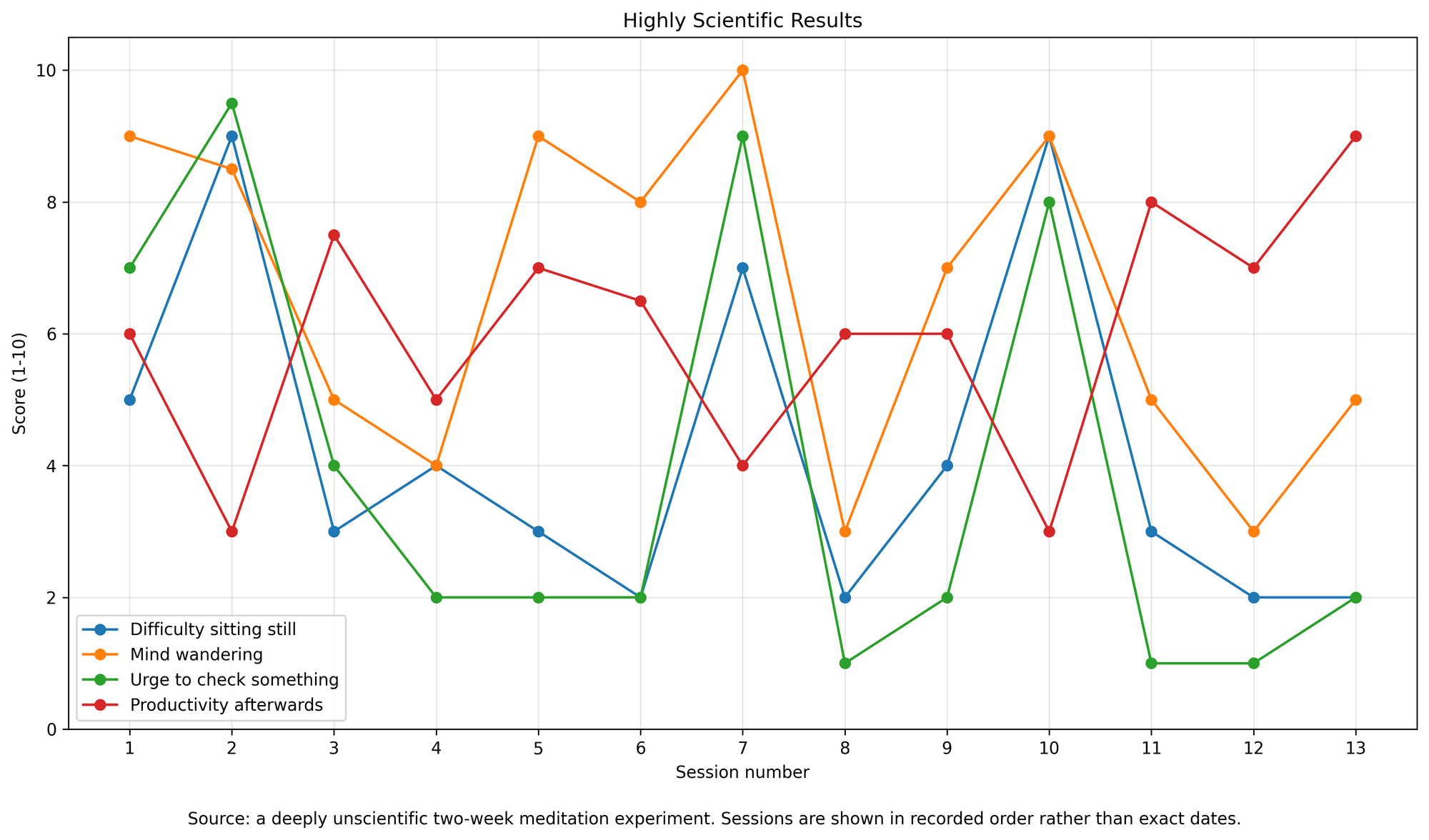
At the end of each session, I recorded how difficult it was to sit still, how much my mind wandered, how badly I wanted to check something and, most incriminatingly, my Productivity and Attention Span Afterwards.
I had somehow unconsciously invented KPIs for staring at a wall.
On the first day I gave myself a 6 out of 10. Another session got a 3. Later there were 7s, 4s, 8s. I kept waiting for the numbers to slyly reveal that these twenty minutes were covertly an investment.
It was possible that meditation could sharpen my writing. Maybe I'd rip through work afterward in a torrid tempest of productivity pointed in the perfectly calculated direction.
It was my hope that the wall would eventually start paying some damn dividends.
What I had intended as an experiment in reclaiming my own mind was seemingly becoming an experiment in whether every part of my life needed to produce something of obvious, tangible value.
Even the rare parts of my life specifically reserved for producing nothing.
My Brain Has 47 Tabs Open
Once I removed the outside noise, I discovered the inside noise had plenty of material to go off of too.
The first few sessions were less like meditation and more like opening the door to a packed storage closet, only to be met with an avalanche of clothing and sports equipment, and other assorted dusty, long-forgotten items.
I thought about fundraising. Tax lawyers. Podcast guests. Making dinner reservations for family coming to town. Laundry. What to cook for dinner. Where to take my wife on Friday date night. Basketball injuries. Vacation. Future articles. Old movies. Random business ideas. Things I needed to schedule. Things I had forgotten to schedule. Things that had absolutely no reason to be occupying my brain at that particular moment.
Nothing urgent. Nothing useful. My brain had simply generated a question and immediately wanted an answer. Perhaps immediate access to AI-enabled search engines has perpetuated the need to scratch that itch.
I had assumed that phones or screens were the problem, or at least a large part of it.
Put the phone down, remove the notifications, stop feeding yourself information, and maybe then everything should go quiet. Sort of like starving out the naughty, sugar-craving microbiome for a few weeks to kill off the unhealthy appetites.
It turns out I had internalized that information feed. My own mind was acting like a heavily overburdened computer operating system, crashing beneath the weight of meaningless search queries and half-baked documents.
Take away the screen, and my brain was perfectly capable of generating its own endless scrolls and loops.
Some thoughts were perfectly legitimate, maybe even useful. I really did need to email that lawyer. Dinner obviously had to happen at some point. My in-laws really were definitely arriving soon.
But these things had apparently formed an uneasy and inconvenient alliance with dozens of completely inconsequential thoughts and agreed to arrive together the moment I stopped to take a beat and try to do nothing.
There was also something vaguely entrepreneurial about the whole experience. Give my brain twenty minutes of unused capacity, and it immediately starts allocating resources of all types.
New article idea. Business idea. Remember that call. Maybe do this next week. What if I structured that differently? Have I booked that guest yet?
I even caught myself composing this piece in my head on several separate occasions while I was supposed to be observing what happened when I stopped working.
For a while I thought this meant I was doing it poorly. I kept trying to clear my mind, focus harder on breathing, stare more intently at the now-familiar wall, find the correct position, become sufficiently Buddha-like to qualify.
Sooner or later, I stopped fighting quite so much.
If a thought appeared, fine. If another followed it, also okay. The goal became less about achieving some pristine blankness and more about noticing how quickly my attention tried to attach itself to whatever passed through.
Neither the noise nor the distracting assaults on my mind subsided. I did, however, become slightly less surprised by how much of it there actually was.
Apparently, Doing Nothing Is Somewhat of a Skill
I am happy to report that something did indeed start to change.
Not enlightenment. Not serenity. I did not begin levitating above the carpet or speaking exclusively in koans despite having a beautiful wooden Buddha statue conveniently placed in my temporary meditation hub.
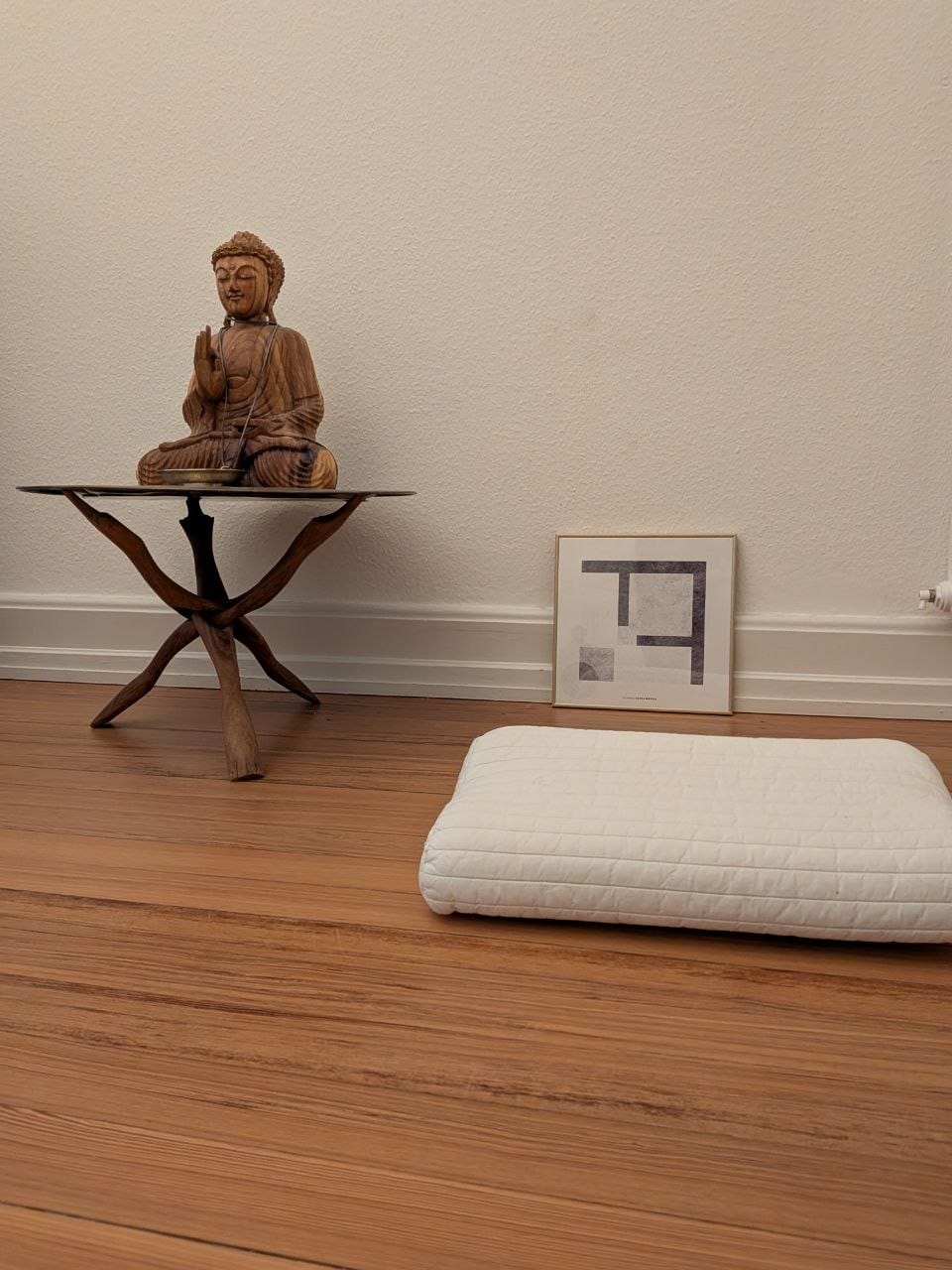
I just got better at sitting still on my little meditation pillow.
During one of the early sessions, the urge to check my phone was so strong that my hand actually hovered over it like a menacing UFO ready to pounce on an unsuspecting farmer.
I wasn't waiting for an important message. I wasn't expecting breaking news. I really just wanted to know how much longer I had to endure this agonizing torture session.
I gave that urge a 9.5 out of 10.
A few sessions later, it had dropped to a 2.
Then a 1.
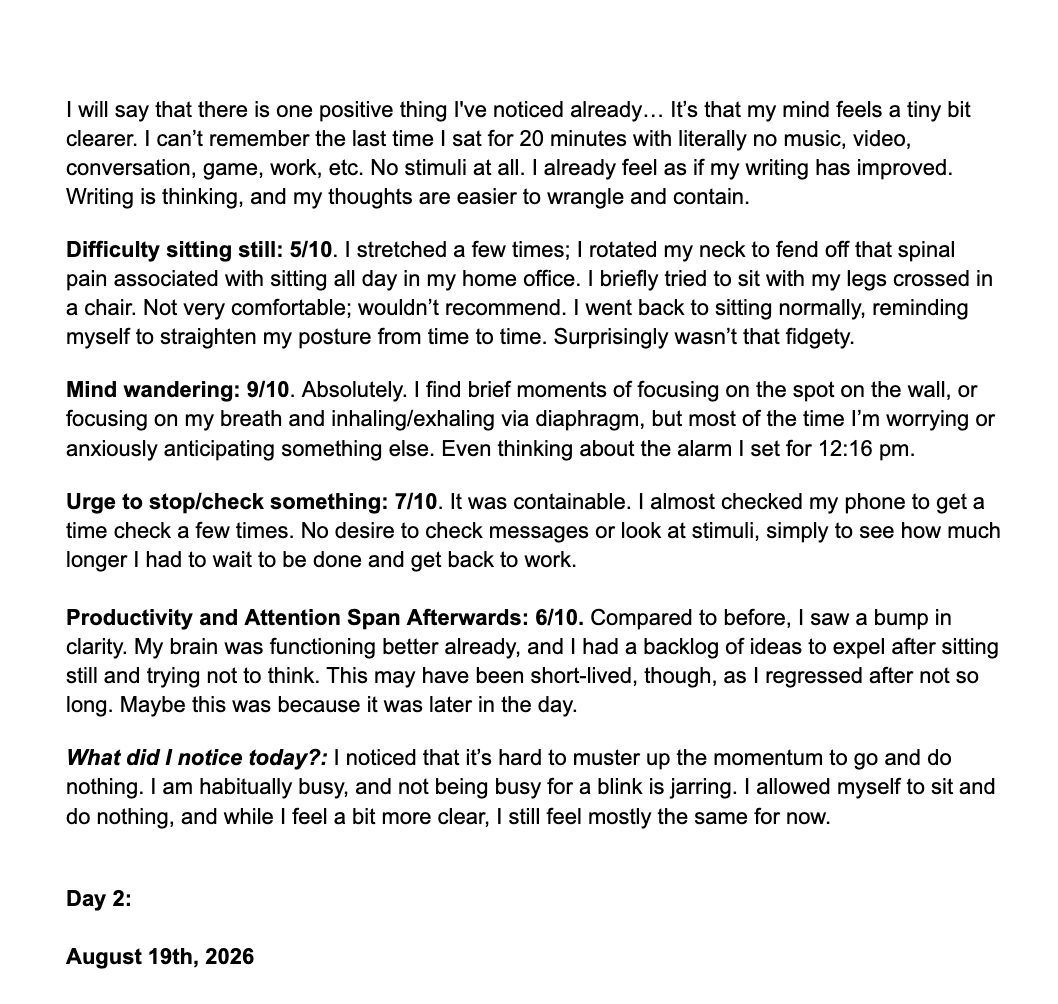
The same thing happened with sitting still. Early on, I was adjusting the chair before I ended up ditching it altogether for a more authentic experience. I constantly found myself readjusting my arms, rotating my stiff neck, stretching my achy bones, fiddling with whatever happened to be within reach.
At one point I found myself mimicking the Buddha statue sitting next to me, presumably hoping some of its serene composure would transfer through some proximity-induced osmosis.
After some time, I could confidently sit for most of the twenty minutes without moving much at all.
My mind hadn’t followed along.
On one of the days when sitting still was easiest, I rated my mind wandering a 9 out of 10. Another day I was physically calm while my thoughts sprinted through articles, calls, vacation, taxes, dinner, and whatever else happened to wander into the room.
I had incorrectly assumed improvement would mean thinking less. Instead, it seemed to mean becoming less bothered by the fact that I was indeed thinking.
My brain could yell something about taxes, and I didn't have to immediately do anything about taxes.
I could wonder how much time was left without checking. Thoughts could arrive without automatically becoming instructions or assigned tasks.
For most of the day, a question leads to Google. A message leads to a reply. An idea leads to a note. A notification leads somewhere else entirely. There is very little distance between my impulses and my consequent actions.
Sitting there introduced a small gap. Eventually twenty minutes stopped feeling quite so much like twenty minutes.
I wrote in my notes that doing nothing had started to feel like a skill that I was honing…
Which is an absurd thing to need to learn or remember how to do.
Enlightenment Gets Cancelled
Unfortunately, human improvement refuses to cooperate with narrative structure.
Just when I had started getting better at this, I had one of my worst sessions.
I couldn't sit still; my mind wandered constantly; I really wanted to check my phone. Eventually I took a quick look to check the time.
Fifteen minutes in.
There were five minutes left.
This was absolutely devastating information.
The attempt felt like a cruel CIA torture session, yet I had no secrets to spill. I was thinking about basketball, dinner, work, anything except breathing or the wall or whatever enlightened people are supposed to be thinking about when they aren't thinking at all.
My productivity afterward was abysmal too…
So much for progress!
A few days later I managed an even worse session at around ten on a Sunday night. My neck hurt. I was tired. My cat had recently slashed my nose, so I spent part of the meditation picking at a dry, bloody scab on my face.
I checked my phone multiple times. I wanted the timer to finish. I was irritated that time refused to bend to my will!
I went to bed wondering if the whole thing had been pointless.
Then, roughly fourteen hours later, I meditated again around eight in the morning.
Almost everything reversed…
I barely wanted to check the time. Sitting still was easy. My mind was quieter. Twenty minutes breezed by. I felt more tranquil afterward.
Same person. Same damaged neck. Same ADHD diagnosis. Same experiment.
Completely different result…
I started to suspect that the variables surrounding meditation mattered at least as much as whatever meditation skill I was supposedly building.
Doing it late, tired and resentful, was a miserable idea.
Doing it early, before the day had started throwing things at me, felt 100% different.
This is not a scientific conclusion. My experimental methodology included botched dates, missed sessions, subjective numerical ratings, and at least one sneaky accidental nap.
But it did manage to puncture the neat story I had unconsciously expected.
Some days were good. Some were terrible. Then the next one was good again.
Much to my annoyance, this appears to be how most things in life actually work.
So, Did This Actually Do Anything?
Does meditation even work?
More specifically, because apparently I am incapable of asking a normal question…
Did it make me more productive?
The evidence was not exactly cooperating with me as I had planned.
In an effort to calculate ROI on my time and energy expenditure, I gave myself a productivity score after every session. Sometimes it was high. Sometimes low. Other times I felt clear-headed and immediately got back to work. Occasionally I meditated and proceeded to accomplish approximately nothing (or continued doing nothing).
I had been thwarted. There was no glorious upward trend line.
The morning sessions generally seemed better. On the final day, I meditated early and gave my post-session productivity a 9 out of 10, the highest score of the experiment.
But even I am not shameless enough to claim that means twenty minutes of meditation increased my productivity by some measurable percentage.
There were other variables in this imperfect experiment to consider. Maybe I slept better.
Maybe I had different work that day.
Maybe knowing it was the last session energized me a bit.
It’s entirely likely that rating your own productivity on an improvised ten-point scale is not going to survive rigorous peer review.
Still, by the end, some things were undeniably different from the beginning.
Twenty minutes no longer felt eternally endless.
I wasn't constantly reaching for the phone. I could sit quietly without feeling like I needed to escape. I sometimes even enjoyed my respite from the grind.
And I increasingly preferred doing it early because it made the beginning of the day feel less like being fired from a cannon into a pile of notifications.
Meditation did not fix my attention. But it did make me notice it a bit more.
I noticed the moment my brain generated an irrelevant question and demanded an answer. I noticed how uncomfortable unallocated time could feel. I noticed that on some days the problem wasn't my phone at all. The phone could sit untouched while the circus continued perfectly well inside my skull.
And that awareness did not suddenly make me a focused person.
I still often lose momentum when something interrupts me. I still open tabs I do not need and will never revisit again, despite my belief in it being so. I still have a brain capable of taking a straightforward task and turning it into six adjacent, meandering tasks.
But there is something quite useful about catching the machinery in motion.
Even if you cannot immediately turn that machinery off.
The ROI of Nothing
My final meditation went as well as I could hope for or reasonably expect.
I sat mostly still. My mind wandered, but not catastrophically. I had family visiting, there was noise elsewhere in the house, and yet twenty minutes passed without much resistance or pain.
I felt quite serene afterward. Grounded, even.
And then I opened my journal and wrote about whether meditation deserved to remain in my routine or not.
After all of this, I was still doing the calculation.
Could I justify twenty minutes every single morning?
Would the clarity afterward compensate for the time spent sitting there?
Or should I remove meditation from my hyper-optimized schedule and use the twenty minutes for something even more productive?
Was there even something more productive I could be doing?
ROI.
I had spent two weeks trying to practice an activity whose entire value may have been that nothing was required of me, and I still wanted to submit an expense report to myself.
The funny thing is that I would never conduct this same analysis before wasting twenty minutes on YouTube.
I don't calculate the return on listening to a song or ask myself whether lunch improved quarterly performance.
I have never finished a movie and wondered whether the two hours should have been reallocated toward operational efficiency.
Some activities apparently get to exist because being alive is allowed to contain things other than output.
Meditation was harder for me to put in that category. Possibly because I scheduled it with purpose, or maybe because it happened during the workday, or maybe even because years in the startup sphere had taught me to treat unclaimed time as wasted capacity.
I don't think two weeks of staring at a wall cured me of that. I might even need two lifetimes of wall staring to fix whatever I’ve got going on.
The one thing I do know after all this: I am going to keep meditating anyway.
I still think twenty minutes is quite expensive. I just have a growing suspicion that the things I refuse to price might be worth even more.