Tech Doesn’t Understand Why You Don’t Like It
Tech companies say people don’t understand the future. Maybe the bigger problem is that tech no longer understands the people expected to live in it.

I saw Mark Zuckerberg cosplaying as a totally normal human person on a podcast with Theo Von that came out in April 2025.
Theo Von asks Mark Zuckerberg if he drinks coffee. And it’s the kind of question that should require one simple syllable.
Zuckerberg replies he does sometimes, mostly when he is on vacation. Recreationally.
I had never really considered coffee a recreational drug before. A drug, surely. Although technically I suppose he has a point.
He explains that he does not particularly like substances that alter his equilibrium.
Why is this exchange so entertainingly off-putting? Mostly because Zuckerberg is clearly trying.
This is not the pale twenty-something founder in a gray T-shirt explaining social graphs to Congress-dinosaurs anymore. He has hair now, baggy clothes, chains, the whole human-being package.
He goes on Theo Von’s podcast and talks about fighting, family, masculine energy, and whatever else normal guys are supposed to talk about on such podcasts.
And yet when Theo goes on to ask him about coffee, the discussion somehow ends up veering towards a talk on equilibrium.
Making fun of Zuckerberg for seeming robotic is ancient internet tradition at this point, and maybe even a bit unfair. He seems capable of laughing at himself now, which is more than we can say about some of the other tech moguls at the tippy top.
More importantly, I am not even sure Zuckerberg is the strange one anymore…
Spend enough time around technology and the whole industry starts to warp minds and sound a little like this.
Perfectly ordinary things are described in increasingly peculiar language.
Companies that sell basic CRM software talk about transforming civilization.
Founders find themselves announcing plans to automate jobs, all while reassuring everyone that workers have nothing at all to worry about and their jobs are safe.
Companies trying to convince the public not to fear robots occasionally unveil something that looks like it was taken straight from Terminator 2.
Everyone involved seems surprised when the reaction is not universal praise or enthusiasm.
Technology has always produced strange people. It probably requires some degree of strangeness to qualify.
Nobody sensible looks at a rocket exploding on a launchpad and thinks, I should spend the next forty years doing this.
So herein lies the problem, and the problem is not that Silicon Valley is weird. Don’t get me wrong, it is very weird.
No, I posit that the real issue is that tech folk can no longer see the weirdness from the other side.
There is an enormous difference between being unconventional and losing the ability to imagine how you appear to somebody who does not live inside your bubbleworld.
Does anyone in tech ever stop to wonder how all of this looks to everyone else?
Does Nobody See How This Looks?!
Want examples? No worries, I came with plenty of receipts.
Take Artisan, for instance.
Artisan is an AI startup that makes digital workers for sales teams. Its big advertising campaign around San Francisco included billboards reading things like “Stop Hiring Humans” and “Humans are So 2023.”
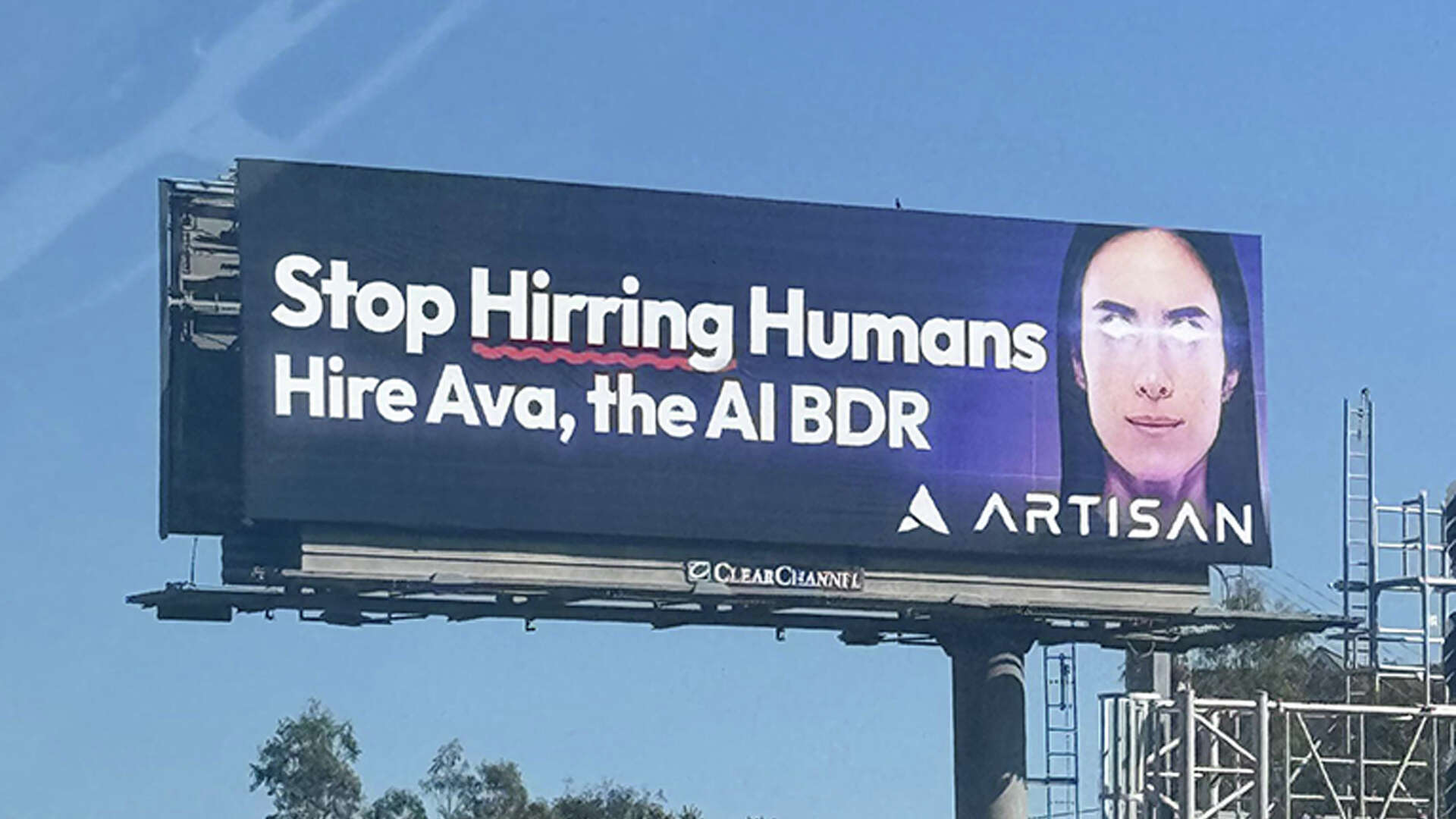
There is a kind of logic to this. I get it; I worked in marketing for ages. The company sells software that does tedious, automatable work humans currently do, and provocation gets lots of attention. Mostly negative. The campaign clearly got attention.
But imagine encountering one of these billboards without having spent the last three years discussing agents, productivity curves, and the economic upside of automation.
Now couple that with the existential fear of losing your livelihood. The thing that people are constantly being reminded of thanks to growing talk of AI-related mass layoffs.
If you’re gainfully employed currently (I won’t assume you are if you’re routinely putting in the Herculean effort to read these lengthy rambling essays), maybe you have spent the last year hearing that artificial intelligence is fixing to snatch away that job of yours. Your company is experimenting with software that can do small aspects of what you do to earn a paycheck. Your boss has suddenly started using the word “efficiency” 100 times more often...
Then on your commute home, some venture-backed AI company has purchased a giant rectangle in the sky to tell you:
“STOP HIRING HUMANS.”
And despite that, tech execs are still playing the victim. Somehow, the technology industry remains confused about why people are nervous about the ever-encroaching threat of technology.
Thankfully, Artisan eventually retired that misguided slogan. They even pivoted to hiring actual humans for sales as well.
Anyway, this is not meant to be an argument against Artisan. The product may indeed be useful for some companies. Automating boring sales work is hardly going to bring on a cataclysmic collapse of civilization. I continue to find myself fascinated by that colossal chasm between what the campaign looked like internally versus the way it has now been perceived externally.
And that ever-widening gulf keeps popping up all over the place…
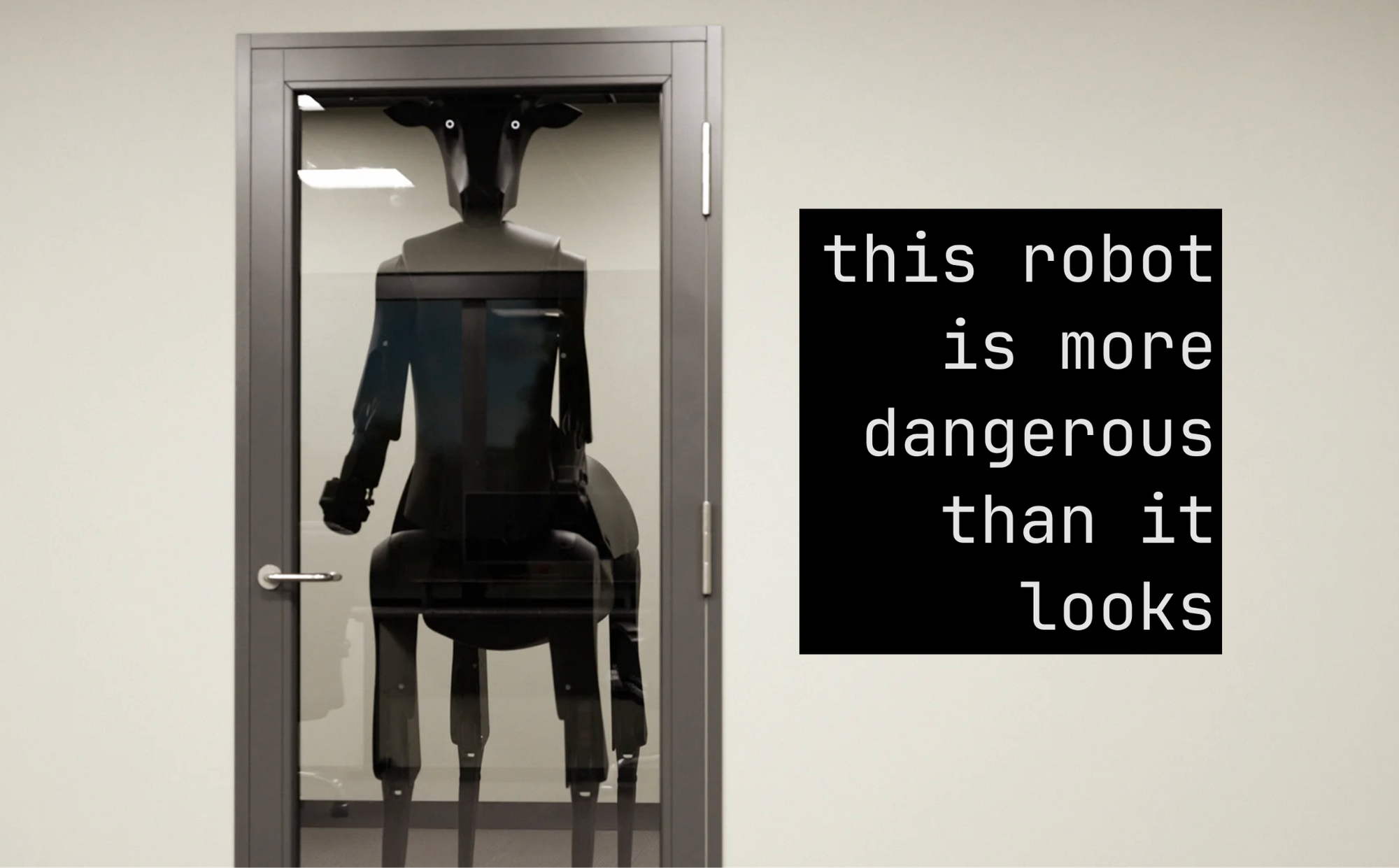
There is a robotics company called Satyress building a machine called Threehalves. In fact, this demonic entity inspired this essay in the first place.
It is designed for genuinely dangerous work, places where sending a human being might get them burned, crushed, maimed, or killed.
I can concede that it may be useful and save lives…
Threehalves is also roughly seven feet tall, black, horned, vaguely goat-shaped, and capable of carrying industrial tools. In promotional images, this sleep paralysis demon has been shown holding a chainsaw.
The company even designed the horns partly so the robot would have difficulty fitting through normal pedestrian doors.
Again, none of this makes the underlying technology useless or unhelpful. Quite the opposite. A machine that can enter a burning building instead of a firefighter sounds pretty ideal.
I, however, do question whether the ideal ambassador for humanoid robotics is something that looks capable of demanding a blood sacrifice to Baal.
There’s no denying that the strategy has yielded some results. The company is on everyone’s radar now, good or bad.
This would all be much, much easier to dismiss as a few companies being deliberately provocative if the same problem did not appear everywhere else.
It has gotten bad enough that comedians are now making fake AI ads that are increasingly difficult to distinguish from the real ones.
And that’s the point I’m trying to get to in my own meandering fashion.
The tech industry has become incredibly good at explaining itself to people who already understand the technology industry.
Everyone else is left staring at the billboard.
The Call is Coming From Inside the House
I work in venture capital, so I should probably admit that I am writing this from inside the insane asylum.
When you spend enough time around startups, you start to recognize the insufferable terminology of the biz. Then those words lose all meaning to you and they become part of the background scenery.
TAMs, moats, flywheels, agents, infrastructure layers, vertical integration, category creation.
There are times to use such terms, but I find most people use them on autopilot, and after a while they become tacky furniture needlessly adorning the most boring conversations you can imagine.
The thing that keeps me most grounded, however, is trying to describe what a startup does to a normal person. Hell, I’ve given up on trying to explain what my own damn company does to my family at this point. I might have an easier time explaining quantum physics to ’em.
I have watched obvious, simple businesses become nearly incomprehensible after being passed through enough pitch decks and LLMs.
A company does something useful. Then fundraising begins. The useful thing needs to become some sort of grandiose platform. The platform needs to transmute into some type of future infrastructure. That infrastructure needs to evolve into a whole ocean-sized ecosystem.
By Series A, there is a reasonable chance the company is no longer selling mere software at all; “welcome to the foundational intelligence layer for the future of human coordination.” Whatever that means…
Lost in all this: the customer still just wants the invoices sent on time.
Some of this is benign. Every industry develops its own distinct vernacular.
The difference here is that startup lingo keeps leaking outward to the masses.
The website speaks like the pitch deck >>> The billboard speaks like the website >>> The founder speaks like the billboard.
Eventually, a company is advertising in the middle of Times Square using very specific terminology only a sliver of a slice of a handful of people even understand.
This might also explain some of the industry's increasingly strange taste.
Like what’s with tech’s fundamental misunderstanding or fetish for misappropriating the works of Tolkien?
A surveillance and intelligence company is called Palantir, after the magical seeing stones.
A defense company is called Anduril, after Aragorn's sword.
A new bank serving technology companies is called Erebor, named for the actual mountain where an evil dragon spends eons carefully guarding its stolen treasure.
At a certain point, calling your accounting startup Steve starts to feel almost breathtakingly revolutionary.
I don't think these people are secretly unaware of Tolkien. Quite the opposite, actually.
The references are attractive precisely because they imply scale, destiny, power, and participation in some much larger mythical tale.
Tech is unnaturally comfortable casting itself in mythological proportions.
The people inside it just happen to be building the future. They are accelerating societal progress. They are transforming civilization. They are moving intelligence forward inch by inch, reshaping work, defeating disease, solving aging, colonizing Mars, harvesting the energy of the sun with a Dyson Sphere, and making humanity multiplanetary.
Some of them may even succeed with some of these outlandish goals.
But I’ve begun to notice… There is a side effect to spending your life around people who talk like this.
Stay in the bubble long enough, and eventually it stops feeling like a bubble.
They Think You Don't Understand
A predictable thing happens when the people outside that bubble object or dissent.
“They simply don’t understand.”
Simpleminded workers worried about artificial intelligence are misunderstanding productivity.
Those pesky artists angry about training data are failing to appreciate technological progress.
Uneducated parents worried about AI in schools are obviously reacting emotionally to a useful and transformative tool.
Oh, and rural communities fighting hyperscale data center infrastructure are none other than misguided NIMBYs.
Actually, anyone in any way alarmed about the future risks appearing as a Luddite, a doomer, a decel, or whatever word currently en vogue means insufficiently excited about where we are headed.
I won’t pretend that this diagnosis isn’t correct from time to time.
Human beings have an exceptional historical track record of panicking about new technologies.

People destroy useful infrastructure for all sorts of stupid reasons. Communities oppose housing they desperately need. Nuclear power has spent decades trapped beneath layers of fear, bad politics, and simple misconceptions.
Foreign governments deliberately exploit legitimate, civil disagreements because divided societies are way, way easier to manipulate.
Imagine how difficult progress would be to achieve if every impossible invention required unanimous approval across the board, including from people who understood it the least.
I will say, there is an arrogance hiding inside the assumption that education inevitably produces agreement. Sometimes people do indeed understand the argument perfectly well, and have merely reached a different conclusion all on their own.
This distinction seems exceedingly difficult for a tech industry that has become accustomed to measurable/definable answers.
Software either works or it doesn't. The benchmark goes up. The latency goes down. The model improves or gets worse. Somewhere there is a graph proving the thing that needs to be proven.
But human beings are inconveniently immune to the allure of such graphs.
They mainly care about who benefits, who pays, who has control, whether they trust you, what happens to their job, what gets built next to their house, and whether the people telling them everything will be wonderful seem to have any conception of their life whatsoever. Ultimately, what helps or harms them directly.
Anthropic CEO Dario Amodei recently described the backlash against AI as fundamentally a crisis of trust. His description of the public mood was unusually candid. Ordinary people, he said, suspect companies and governments are “cooking up some new way to screw them over.”
That is probably true.
His proposed remedy to the situation is also revealing. Amodei argued that grand promises about AI curing cancer have become clichés, and that the industry will regain trust by actually beginning to deliver on some of those promises.
I sincerely hope he is right about curing cancer, but I’m less convinced it solves the entire problem.
A person can believe that artificial intelligence might someday cure diseases and still wonder whether their employer intends to use it to eliminate their department next year.
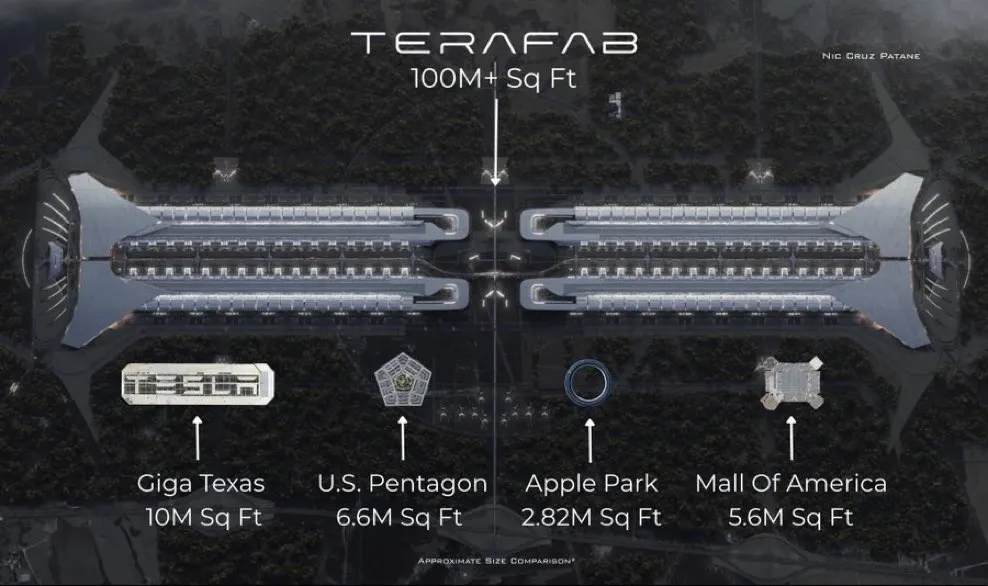
They can want better technology and dislike the company installing a cyber fortress like the proposed Terrafab SpaceX factory getting built in Texas that will be larger than 2,300 football fields or the combined area of Monaco, Vatican City, and Gibraltar altogether.
Humans are complex creatures, capable of holding multiple, seemingly conflicting views at once.
This is where a lot of technology messaging seems to break down. The industry keeps trying to grow the upside and shove it down everyone’s throats, when people are simultaneously asking about the downside facing them both now and down the road.
Which brings us to those hyperscale data centers…
Nobody Asked the Neighbors
From inside the AI industry, the case for data centers is pretty straightforward.
These LLMs need compute. Compute requires chips. Chips require enormous amounts of electricity and physical infrastructure.
The United States is now competing with China for leadership in a technology that may shape the next several decades of economic and military power. Some are even calling it the next nuclear arms race or Cold War redux.
If you truly believe AI will be that transformative, then of course it’s easy to sell the line of thinking that this is all for the good of the nation and critical for national security.
Now imagine you live next door to one of these data centers. You have no equity in OpenAI. Hell, you don’t even use ChatGPT at all.
NVIDIA’s market capitalization does not pay your electric bill for you.
Nobody invited you to the WEF in Davos.
Elon Musk won’t pay your medical bills when his Memphis data center pollutes your breathing air with carcinogens.
A developer arrives with plans for a facility covering hundreds of acres, drawing huge quantities of electricity and potentially water, and promises jobs, investment, and participation in the glorious age of artificial intelligence.
Your questions may be slightly more provincial.
How loud is it?
or
Who pays for the grid upgrades?
or
What happens to electricity prices?
or
How much water does it use?
or
How many permanent jobs does it actually create?
or
Why here?
or even
What do we get?
Those are not anti-technology questions. They are perfectly reasonable. The type of questions people ask when someone wants to build something enormous next to their home.
Gallup found this spring that seven in ten Americans opposed an AI data center being built in their local area, including 48 percent who strongly opposed one. I, for one, thought that number would be higher. Concerns from those in the survey included electricity demand, water use, environmental effects, and local power bills.
There is also a foreign interference angle at play here.
OpenAI just disclosed in June that it had banned a cluster of accounts likely originating in China that were being used to create American-facing social posts attacking US data center construction.
The campaign supposedly tried to amplify concerns about electricity prices and local impacts.
So the people claiming China is trying to exploit the issue might not be completely hallucinating.
OpenAI found no evidence that the operation achieved meaningful breakout beyond its own activity. Its own report describes the controversy as a legitimate existing American debate and says the operators were attempting to exploit concerns people already held.
China never needed to manufacture dissenters in America.
It merely noticed they already existed and capitalized on it.
This has not stopped a large faction of the technology sphere from clumsily reaching for foreign influence as an explanation for the perfectly understandable backlash.
There is something remarkably self-preserving about this broken logic.
This is the most important infrastructure built in over a century, and rational people should therefore support it. Opposition threatens American technological leadership, and China benefits from the chaos.
The people opposing us are consequently, knowingly or otherwise, helping our enemies over in China.
No awkward period of introspection required.
Surprisingly, Texas Governor Greg Abbott offered a less flattering explanation earlier this week.
Abbott has hardly built his political career opposing business development or American technological leadership, to put it lightly.
Last year he was heavily championing Texas as an epicenter of AI investment. Now, amid mounting opposition, his tune has changed significantly. He now says the data center industry “basically dug their own grave.”
His complaint was quite simple: developers moved too quickly and failed to get the support of the communities where they wanted to build. How refreshingly mundane and uncomplicated.
There was no great information war or grand ideological struggle.
Who would have guessed that asking and talking to the neighbors and maybe even inviting them to the party would have helped avoid calamity.
This is where tech's relatability problem stops just being embarrassing and becomes its real Achilles' heel.
You can survive having your ads mocked on the subway, but building a hyperscale data center is a different matter entirely.
When Parody Stops Working
Earlier this year, a quote attributed to Jeff Bezos began circulating online. It was something suitably Bond-villain-esque, even by billionaire standards.
According to the quote, Bezos had supposedly suggested that human beings consume too much water and that preserving water for artificial intelligence might be more important because AI could eventually benefit humanity.
Well, he never said that. It was satire. The issue was that quite a lot of people believed it. Hell, I even believed it for a split second.
The reaction was more interesting than the fake quote itself.
“Sorry about the drinking water. The machines need it.”
And the public response was, essentially, “Yeah, sounds plausible.”
And this is happening elsewhere too.
Comedians Harris Alterman and Dave Ross started making fake advertisements for imaginary AI companies because real AI advertising had become so formulaic.
One fictional company offered “panties that think.” Another appeared to announce that Ziplink had become Froggle.
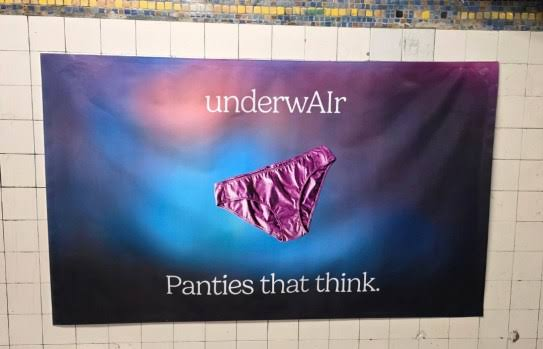
The joke works because there is a moment where you have to do a double take.
We have RentAHuman describing people as the “meatspace layer” for AI.
We have companies advertising the automation of human workers.
We have startup founders talking about fully automating work.
We have real billboards that require local newspapers to explain what the advertisements mean.
Satire traditionally takes reality and pushes it somewhere absurd.
Technology keeps arriving at something more than absurd, much quicker.
And beneath that obvious comedy lies something a bit more troubling. If people can easily believe that a billionaire wants their drinking water for a computer, the industry has a reputation problem that cannot be repaired by changing the font or the lingo.
People have developed a mental model of the technology class in their great ivory towers.
It is enormously wealthy. It is powerful. It believes in the future. It speaks in grand abstractions. It is willing to disrupt almost anything. It has been telling everyone for years that artificial intelligence will transform civilization beyond recognition whether you like it or not.
Then it seems genuinely offended that the rest of society has started taking some of this delusional techspeak literally.
Eventually, People Get a Vote
For much of the last twenty years, Silicon Valley could afford to be unrelatable in a way it increasingly cannot.
A strange founder could build an app, give it some dumb misspelled name, and you could download it or ignore it. Even enormously consequential software companies rarely needed the approval of your town council, your utility provider, or everyone living three streets away.
That is now changing.
Artificial intelligence requires power plants, transmission lines, chips, factories, and enormous data centers. Robotics will increasingly put machines into workplaces and public spaces. Autonomous systems will affect transport and defense. AI will change how companies hire, fire, and organize us regular folk. It is already seeping into our schools, hospitals, creative industries, and even our relationships!
The physical footprint of technology is getting several orders of magnitude larger at exactly the same time its cultural relationship with the public is getting worse.
That is a combustible combination.
Public opinion is already becoming political reality. Data centers have become a hot-button issue ahead of the US midterms.
States and local governments are considering moratoriums, rolling back incentives, and imposing new requirements.
There is a temptation inside technology to see this as another obstacle that eventually gets routed around… Maybe.
History is also full of useful technologies that societies delayed, restricted, rejected, or regulated into much smaller forms because their advocates lost the public argument.
Being technologically correct does not guarantee political permission.
An industry that wants to rebuild the energy system, transform employment, and introduce increasingly capable machines into ordinary life is going to need more than technical superiority.
For starters, it’ll need to earn the trust of the people it hopes to serve if they are indeed sincere in that goal.
And trust gets harder to demand after you have spent years telling those same people that disruption will be good for them.
And unlike an adoption curve, those people eventually get a vote.
Understanding People Shouldn’t Be a Moat
There are people inside technology who seem to understand this.
Airbnb founder Brian Chesky recently argued that Silicon Valley needs to build more AI products that ordinary people actually love. His complaint makes a lot of sense.
Of the previous 175 Y Combinator companies he cited, 159 were focused on enterprise rather than consumers. Chesky's basic argument was that people may feel differently about AI and start to forgive the intrusion, when and only when it begins producing obvious improvements in their own lives.
That seems almost embarrassingly sensible.
People generally become more enthusiastic about a novel technology when it does something they want or need…
The smartphone did not require Steve Jobs to write a manifesto explaining why everyone should care about mobile computing, nor did Google need Americans to study information retrieval before they appreciated finding things online.
The product just went ahead and made the most compelling argument.
AI may eventually do the same. But usefulness only solves part of the problem.
The larger moat may belong to those companies capable of understanding the objections before dismissing them outright.
A founder should be able to wrap their head around reasons why someone might hate what they are building.
A data center developer should understand the argument of the homeowner directly across the street.
An AI company should probably find a more empathetic way to discuss job displacement without buying a billboard that says “Stop Hiring Humans.”
Maybe a certain aforementioned robotics company may even consider giving the lifesaving machine slightly smaller demon horns. You know, just normal-sized demon horns.
None of this requires abandoning or limiting ambition either. You can keep your total addressable markets that are larger than the combined economic output of ten Earths.
I personally still want to see people building strange and useful things that help improve our everyday lives. In fact, I invest in people building strange things. The world would be unbearably dull if every founder waited until an idea sounded reasonable and easy to grasp to everybody at dinner.
Technology needs the obsessives, weirdos, eccentrics, and people whose relationship with coffee may be slightly more recreational than the rest of ours.
More importantly, it could also use a hell of a lot more humility.
Silicon Valley is extraordinarily good at imagining futures, but it would do itself a world of good spending more time understanding the people who have to live in them.