The Most Observed Event in Human History
The 2026 World Cup became a global test bed for facial recognition, robot dogs, counter-drone systems, and surveillance infrastructure built to last.

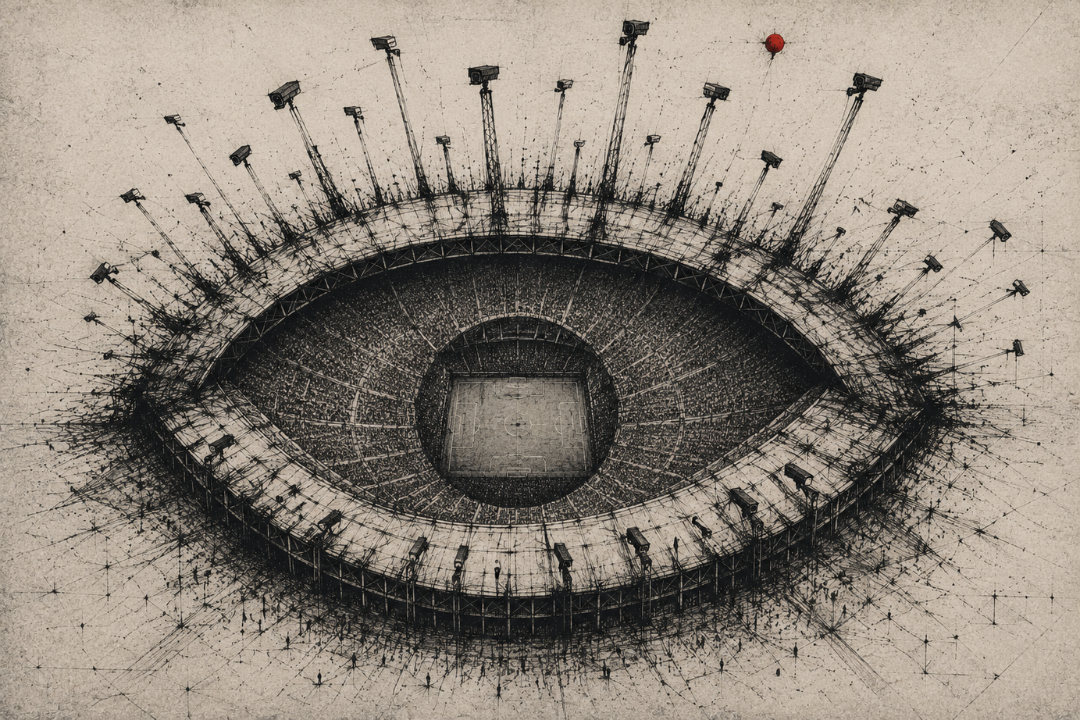
The line moves fast.
Faster than you expected or remembered. Faster than thousands of impatient souls wearing overpriced replica shirts should be able to funnel themselves into a stadium without causing at least one minor riot, one broken turnstile, or one man discovering at the worst possible moment that his phone battery is dead.
You opted into the system before you arrived.
Perhaps you did it while purchasing the ticket. Perhaps it was one of those boxes you clicked while distracted, exhausted, or deeply uninterested in reading another fourteen million words of terms and conditions written by a law firm that regards human comprehension as a security vulnerability.
Now you look up and notice a camera catching a glimpse of your mug.
Somewhere behind a wall you cannot see, a system compares that face against the biometric profile you enrolled, connects it to your ticket, verifies that you are apparently who you claim to be, and opens the gate.
No codes. No stamps. No bracelets.
You do not hand anything to anyone. In fact, you do not even need to remove your phone from your pocket.
That whole exchange took maybe four or five seconds? Could be even less.
A bored stadium employee lazily ushers you through with the maximum level of disinterest and apathy permitted under modern employment law. The look on their face tells you that this happens a few thousand times per hour.
At Gillette Stadium, the same voluntary facial-authentication system was designed to let registered fans connect their faces not only to their tickets, but to their payment methods as well.
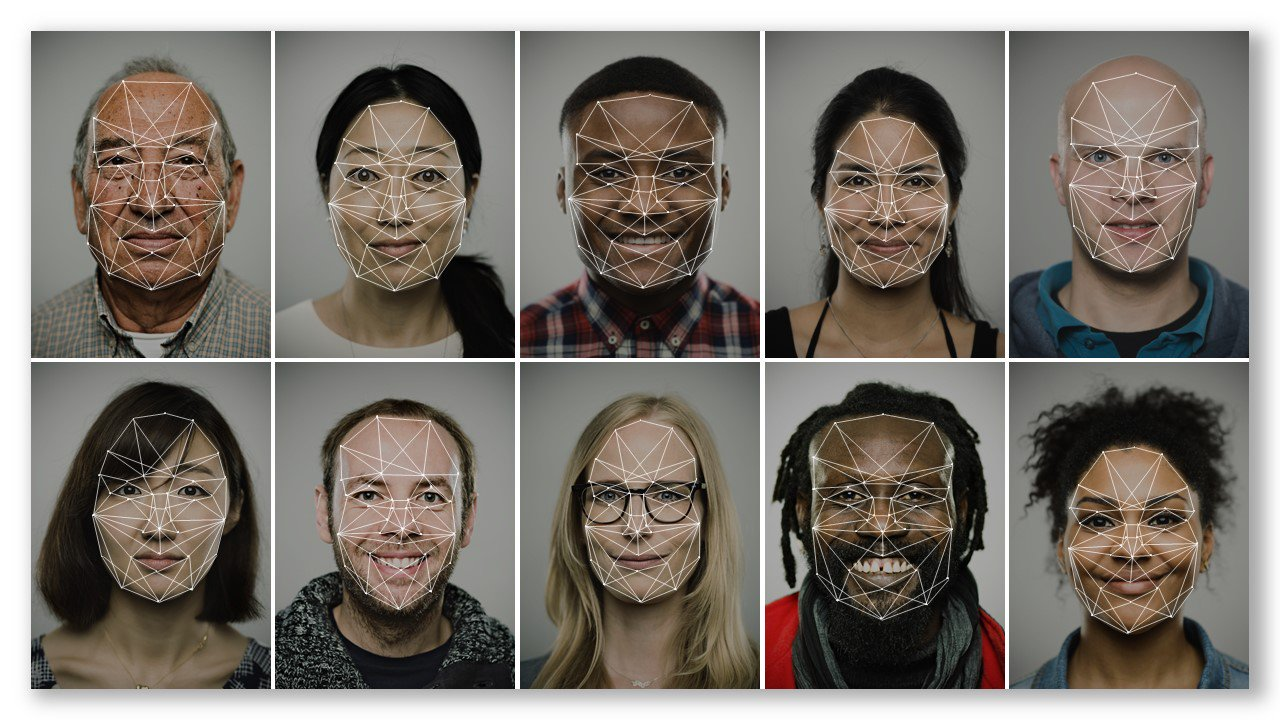
Somewhere in that very same building, a concession stand can use the same system to sell someone a watered-down beer and a hot dog priced as though the animal had been raised by hand in luxury, educated at an Ivy League university, and slaughtered during a private ceremony conducted by a Michelin-starred chef and a high priest.
Congratulations, your face just became your ticket.
Then your face became your wallet.
And your wallet got you into the world’s biggest sporting event without a word being muttered.
Convenient, isn’t it?
The best tricks are the hardest to catch.
Somehow none of this feels like surveillance. What it does feel like is damn good service in the modern age.
The Most Surveilled Show on Earth
The World Cup was a month-long defense technology convention disguised as a football tournament, and millions of fans were invited to become unpaid beta testers.

Spain may have snatched the trophy away from Argentina on Sunday, but the surveillance and defense technology industries walked away with something that may eventually prove far more valuable.
A live demonstration. A case study. Obvious proof of scale.
A month of operational data gathered from the largest sporting event on the planet, played across 104 matches, 16 host cities, and three countries.
I would like to call it the most surveilled event in human history.
Unfortunately, humanity has not maintained a reliable historical scoreboard for cameras pointed at civilians per square foot, so proving that claim with any intellectual honesty is nearly impossible (but I’m going to continue calling it that regardless).
It was, at the very least, one of the most technologically sophisticated security operations ever wrapped around a sporting event.
Facial authentication turned human faces into tickets and payment credentials.
Four Boston Dynamics robot dogs joined the security operation. Two were deployed at the International Broadcast Center in Dallas, while two more operated at MetLife Stadium, where the final was played.
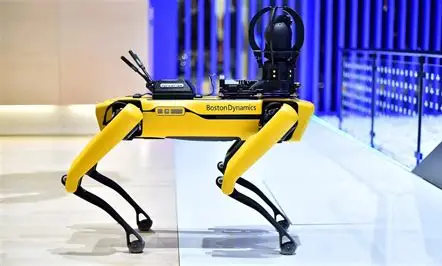
They carried cameras into areas where human security teams needed additional reach, inspecting perimeters, monitoring assets, and helping investigate suspicious packages or potentially dangerous materials.
Above the stadiums, counter-drone systems scanned the sky.
Fortem Technologies received a multimillion-dollar order to deploy radar, command software, and autonomous DroneHunter interceptors capable of pursuing unauthorized drones and capturing them in nets.
Lenovo built an Intelligent Command Center that gave FIFA a centralized, real-time view of tournament operations, allowing organizers to observe activity, identify emerging trends, and respond across the enormous footprint of the competition.
FEMA alone awarded $625 million to the eleven American host cities to strengthen security operations and protect the communities hosting the tournament.
That was not purely a technology budget. It also covered the sprawling human machinery required to secure an event of this scale, including planning, exercises, police, emergency response, cybersecurity, personnel, and coordination.
It also does not include every additional dollar spent by local authorities, the wider federal government, private operators, Canada, or Mexico.
Sixteen cities.
Three countries.
One hundred and four matches.
Millions of people passing through an unprecedented web of cameras, sensors, databases, autonomous machines, aerial defenses, and centralized command platforms.
The Tradeoff
Each individual component arrived carrying a perfectly reasonable explanation and probably a laminated visitor badge.
At one point, estimates for getting into Gillette Stadium were hovering around one hour to clear security. And what did we receive in exchange for this strange new intimacy?
Faster entry. Shorter lines. Protected airspace. Safer tunnels. Better crowd control.
Fewer opportunities for fraud, violence, terrorism, catastrophe, or some drunken halfwit launching a consumer drone into the flight path of a passenger aircraft because he wanted a better photograph for social media.
I do not want stadiums bombed.
I do not want drones crashing into crowds.
I do not want thousands of people compacted into a narrow entrance until the collective mass of humanity begins behaving like toothpaste being forced through a tube.
I am not suggesting that security personnel protect millions of people using binoculars, whistles, smiles, and positive thinking.
Some of these systems probably made people safer.
Some may have prevented incidents we will never hear about, silently detecting a threat, identifying a weapon, diverting a crowd, or stopping some terrible chain of events before it gathered enough momentum to become a breaking-news chyron.
I am going to venture out onto a very sturdy limb and assume that most reasonable people agree with me on these points.
Well, that is exactly what makes the question so difficult. And what makes this piece worth writing too…
There is no single moment when someone announces that you now live inside a panopticon. The panopticon will not be televised! There is no dramatic vote. No emergency broadcast.
No grim-faced government official appears on television wearing an ominous black uniform to inform the public that privacy has officially been cancelled due to budgetary constraints and the need for a more seamless customer experience.
There are only thousands of individually reasonable decisions, each made by sensible people attempting to solve a legitimate problem.
One camera. One database. One emergency grant.
One faster entrance. One safer stadium. One more convenient, tasteless beer. We don’t need threats to surrender our privacy when faster lines and more convenience will suffice.
That is how the machinery always arrives. It smiles pleasantly, saves you four seconds, remembers your preferred payment method, and asks whether you would like to opt in for an even smoother experience next time. The bane of privacy.
At some point, opting out begins to feel like punishment.
The biometric entrance takes seconds. The alternative requires a phone, a code, a document, a queue, and the patience of a medieval monk illuminating a manuscript during a famine.
Technically, you still have a choice.
Technically, you are also free to walk four hundred miles instead of taking an airplane.
Temporary surveillance should come with a demolition plan.
A date when the cameras come down. A date when the data disappears. A public explanation of who can search it, what it can be used for, and whether the police, the stadium, the technology vendor, or some future owner can quietly expand its purpose after everyone has stopped paying attention.
Instead, temporary usually describes the justification. The machinery itself develops roots.
By the time anyone pauses to ask what has been built, it is already humming behind the walls and forgotten about.
Infrastructure Never Leaves
Matthew Guariglia, a policy analyst at the Electronic Frontier Foundation, has spent years warning about this tendency.
Technology installed for one extraordinary purpose rarely remains confined to that purpose. Once the cameras, fiber connections, databases, control rooms, contracts, and institutional permissions exist, they become infrastructure.
Infrastructure has a peculiar quality.
It does not like to leave.
Qatar installed more than 15,000 cameras to secure the 2022 World Cup. They watched stadiums, transit systems, surrounding areas, and crowds arriving from every corner of the planet.

The tournament ended. The cameras, cables, control rooms, contracts, and trained operators did not spontaneously evaporate.
The concrete remained. The cables remained. The command rooms remained. The knowledge of how to operate them remained. Most importantly, the belief that this level of observation was now normal remained.
Cameras are not folding chairs. They are rarely packed into the back of a van with the temporary fencing and driven away once the final whistle blows.
There has been plenty of attention paid to the lenses themselves, especially the visibly creepy ones perched above roads or swiveling from stadium ceilings like metallic carrion birds.
The lens is only the most obvious part.
The more important questions live behind it.
Who owns the feed?
Who can search it?
Who can add a name to the list?
Who decides what constitutes suspicious behavior?
Who gets to change those rules six months later, when the tournament is over, the public has moved on, and the original promise has dissolved into the bureaucratic mulch?
The camera watches and the permission structure decides what the watching means.
Who Gets to Define a Threat?
This did not begin with the World Cup.
The tournament simply provided an especially gaudy excuse to stare at machinery that has been quietly colonizing public life for years.
A few weeks earlier, across the Hudson at Madison Square Garden, the Knicks played their first NBA Finals games at home in twenty-seven years. They would eventually defeat the San Antonio Spurs and win their first championship since 1973.
The arena was packed with celebrities, season-ticket holders, exhausted fathers, screaming children, corporate guests, and people who had traded a kidney on the secondary market for seats somewhere near the roof.
Above and around them sat one of the most extensive facial-recognition systems ever deployed by an American entertainment venue.
MSG Entertainment originally presented the system as a security tool.
Then the definition of security began to slip and slide and wander.
For years, the company used facial recognition to identify and remove lawyers employed by firms involved in litigation against it. Somewhere between nine hundred and fifteen hundred attorneys reportedly found themselves placed on an exclusion list, not because they posed a physical danger, but because their employers were professionally inconvenient.
A woman accompanying her daughter’s Girl Scout troop was separated from the group at Radio City Music Hall.
A father was reportedly pulled aside in front of his son at a Rangers game.
New York’s attorney general raised concerns that the policy could violate anti-discrimination law.
A state senator described what it increasingly resembled, a private company using biometric surveillance to punish its critics.
Then came the database.
According to reporting by WIRED, which MSG disputes and has challenged in court, a private talent system contained information on roughly 40,000 celebrities and public figures. Some entries reportedly included race, gender identity, sexual orientation, risk ratings, and labels such as “DO NOT HOST.”
One entry concerned a teenager in Colorado who received a visit from local police after posting something unflattering about the company’s owner online.
Perhaps the child posed a grave threat to public safety. Maybe the republic was wobbling beneath the force of one adolescent tweet.
Perhaps the security system had become something else entirely. At what point does public safety become private power with a watchlist?
Who controls the definition of danger once the infrastructure exists?
And what prevents “dangerous” from slowly mutating into “annoying,” “critical,” “litigious,” “embarrassing,” or merely “someone the owner does not like”?
The same question follows us outside the arena.
Flock Safety’s automated license-plate readers now operate across thousands of American cities and communities, recording vehicles as they move through neighborhoods, intersections, shopping districts, and public roads.
The systems are sold as tools for finding stolen cars, locating suspects, and solving crimes more efficiently.
Once again, the thesis is perfectly reasonable.
Until somebody gets access, that is.
Reporting has uncovered multiple cases of police officers using license-plate systems for personal reasons, including an officer accused of searching for and tracking an ex-girlfriend.
Once a system exists, its purpose is no longer determined solely by the reason written in the procurement document. It becomes whatever the next authorized person can persuade themselves is necessary.
Privacy is not disappearing equally either. For most people, surveillance is something performed upon them. For the wealthy, it can be purchased, commanded, and pointed outward.
The ordinary spectator surrenders their face for a faster entrance… The powerful purchase a system capable of deciding whose face may enter at all.
Who Owns the Machine?
Every time the line moves faster, somebody gains something.
The spectator gains convenience. The stadium gains throughput. The security team gains visibility. And the police gain searchable information.
The vendor gains a successful deployment, operational experience, commercial legitimacy, and an impressive new slide for the next sales presentation.
Public money helped build that showroom. A touching little act of involuntary venture support from the taxpayer.
The fans supplied the operating environment, one scanned face, one opened gate, one tracked movement, and one frictionless purchase at a time.
The companies left with proof that these systems could survive millions of people, enormous pressure, international attention, and the logistical bedlam of the world’s largest sporting tournament.
A camera sees a face.
A ticketing system knows a name.
A payment processor knows what you bought.
A license-plate reader knows which vehicle arrived.
A police system may know where that vehicle has appeared before.
Elsewhere, another database may know your employer, your law firm, your risk score, or something foolish you posted online when you were fourteen and briefly believed your opinions were both original and necessary for civilization.
Each system holds a fragment. And power accumulates in the places where those fragments can be connected.
The company manufacturing the camera may not actually own the machine in any meaningful sense.
The company controlling the interface, the permissions, the integration layer, and the searchable record may understand far more than the camera ever could.
And the person being understood may have no idea that the profile exists.
The Reference Customer
Any company that can say its technology operated successfully inside a sixteen-city, 104-match international security operation now possesses the only sales asset that truly matters.
Proof at scale.
Airports will want it. Schools will want it. City governments will find reasons to want it, especially after being shown a polished case study filled with reassuring graphs and photographs of happy families moving rapidly through gates.
The tournament was never the end market.
More like a grand debut. A true reference customer. The world’s biggest tech show.
The Pitch Deck for the Panopticon
Last week, I introduced this publication by admitting that I still do not know whether working inside venture capital makes me a Trojan Horse or merely another well-dressed accomplice.
A few angry villagers on Reddit arrived shortly afterward carrying torches, pitchforks, and several reasonably phrased questions about what ethical dilemmas I was actually referring to.
Fair enough.
This is exactly the kind of problem I was talking about.
Because I fortunately or unfortunately understand every layer of this system.
Identity verification at the gate. Command platforms watching from behind the wall. Counter-drone systems patrolling the sky above the stadium. Police technology stitched across the city. Payment processing waiting quietly beside the beer line.
Every layer had a founder who could explain exactly what problem they were solving.
Every company had a business model that made sense on a whiteboard.
Every market was large enough to generate excitement, competition, recurring revenue, and the peculiar glint that appears in an investor’s eye when the total addressable market begins acquiring extra zeroes.
The company hired to hunt drones over World Cup venues did not emerge from a cave beneath the Pentagon.
It was backed by recognizable institutional capital, including Lockheed Martin and Mubadala.
That is a perfectly normal-looking cap table.
I can imagine the pitch deck. I can imagine the market-size slide.
I can imagine the founder explaining that the product protects civilians, prevents catastrophe, reduces strain on law enforcement, and solves a threat that will only become more dangerous as drones grow cheaper and more autonomous.
I can imagine being interested. Because I would be.
Useful technology does not automatically create a good world.
A profitable company can solve a genuine problem, serve willing customers, save time, prevent harm, and generate a splendid return while still contributing to a society I fundamentally do not want to inhabit.
These decisions rarely feel sinister inside the room.
Nobody opens an investment committee meeting by dimming the lights and unveiling a presentation titled “Constructing the Surveillance State, Seed Round.”
They discuss fraud reduction. Throughput. Public safety. Customer experience. Unit economics. Market expansion. The return profile…
They discuss whether the founder is credible, whether the product works, whether customers will pay, whether competitors can copy it, and whether the company can become the dominant provider of something that did not exist as an industry ten years earlier.
Each company solves a recognizable, sometimes obvious problem.
Each investor can defend the individual decision.
The aggregate is nobody’s line item. Every component arrived with a perfectly reasonable explanation.
That sentence describes the World Cup security operation.
It describes Madison Square Garden’s watchlists and databases. It describes the camera over the road. It describes a Tuesday afternoon investment committee meeting.
This is one of the many ethical contortions at the center of investing in novel technologies.
We are asked whether a company can succeed.
We are rarely forced to answer what happens to the rest of us if it succeeds completely.
Almost nobody votes for the surveillance state.
They get sold a football match, a faster line, a safer city, or a good return.
The Cameras Didn’t Go Home
A few months from now, the World Cup will already be turning into pub trivia.
The banners will be gone. The temporary barriers will have been dismantled and hauled away.
The original trophy will return to Zurich. A replica will sit beneath museum lighting while tourists pose beside it and argue over whether the final was actually any good. (It wasn’t).
The stadiums will return to their ordinary business.
More matches, events, concerts. More people passing through those tech-infused arches and gates.
Above them, the cameras remain resolutely mounted.
Behind the walls, the systems will continue humming, searching, matching, logging, and remembering.
Nobody will even need to make a dramatic decision to keep them alive. There will be no ceremony for turning them off.
The fans went home.
The cameras did not.