FIELD NOTES #01: Elections, Big Tech, and Broken Trust
Brazil, Serbia, Israel, Starlink, unaffordable cities, corporate family trees and the strange machinery of democracy in an unusually volatile October.

Well, apparently Field Notes survived its pilot episode.
This is encouraging because #00 was originally invented as the easy week. A casual monthly dumping ground for the things rattling around my coconut that had not yet mutated into full essays.
Naturally, I then spent an unreasonable amount of time agonizing over the shape it could take.
Classic me.
Anyway, I think I understand the assignment a little better now. Field Notes can be the place where I don't have to know exactly what I think yet. Finished arguments are welcome, but so are suspicions, bad ideas, experiments in progress, things I am probably wrong about, and bits of modern civilization I would like somebody else to explain to me.
Which is useful, because October has given me a lot of material and very few clean conclusions.
The Ground Is Moving
Brazil's stock market threw a big ol’ extraordinary tantrum on Monday morning.
Lula had just won another term as president, surprising investors who had spent weeks positioning themselves for a Flávio Bolsonaro victory. The reaction was immediate. Brazil's main stock index plunged 13.9 percent, the real fell sharply, and trading briefly hit a circuit breaker. Investors had been betting on and hoping for a more market-friendly outcome. Democracy messed everything up!
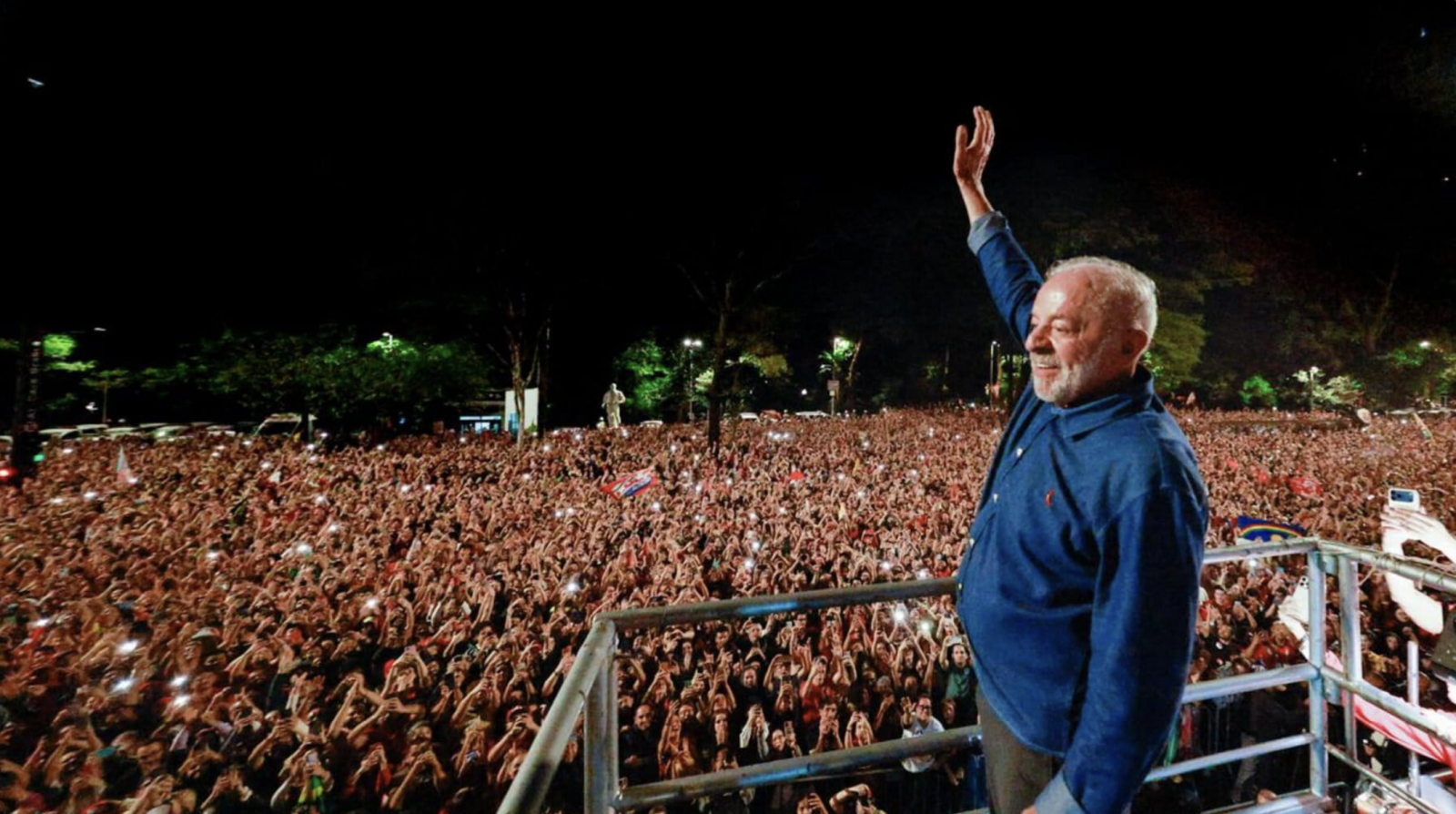
There is something a bit depressingly revealing about watching billions of dollars evaporate because voters had the audacity to not align themselves with the stock market.
Markets have political preferences too. Lower taxes, deregulation, spending restraint, and governments considered friendly to business tend to make capital cozier. And it ain’t a mystery why. Well, at least not for people who have the fortune or misfortune of working close to large amounts of capital for a living.
Still, we often talk about "the market" as though it were weather patterns.
Markets reacted negatively.
A cold front swept across São Paulo. Atmospheric pressure fell over Petrobras.
Behind the passive language are people betting on which political arrangements will make them the most money.
Democracy has a funny way of ruining those trades.
Lula's first response after winning was interesting for another reason. He accused foreign digital platforms of interfering in Brazil's election and said his next government would regulate them, arguing that enormous technology companies should not be making billions while trying to influence an election.
Whether his proposed remedy is wise is another question entirely. Giving governments more control over political speech carries some fairly obvious dangers of its own.
But the accusation points at something we still have not properly figured out.
Technology companies have inserted themselves and become a critical part of the machinery of democracy without ever really being designed for that purpose. They are advertising businesses, communications infrastructure, news distributors, political battlegrounds, digital town squares, and algorithmic gatekeepers all at the same damn time.
Unfortunately for us, nobody elected them.
They just willed themselves into existence.
And Brazil was only one piece of a very strange political week, by the way.
In Serbia, a student movement born from protests over corruption and the deaths of 16 people in the Novi Sad railway station collapse did something far more difficult than filling the streets with mobs of people. It won an election.
After nearly two years of protests, Aleksandar Vučić conceded defeat. The student-backed list was projected to take roughly 135 to 140 seats in Serbia's 250-seat parliament, with turnout nearing 70 percent.
I’ve been feeling a bit anxious about the global political landscape as of late. This one gave me a sliver of hope.
People believed the system was failing them, spent two years demanding accountability, organized, voted, and actually changed the government through sheer willpower.
That is more or less what the machine is supposed to do.
Israel voted this week too, in its first national election since October 7, 2023 and the wars that followed. As I write this, the result has produced another fractured parliament, with neither Benjamin Netanyahu's bloc nor the main opposition holding an obvious governing majority. Turnout was extraordinarily high.
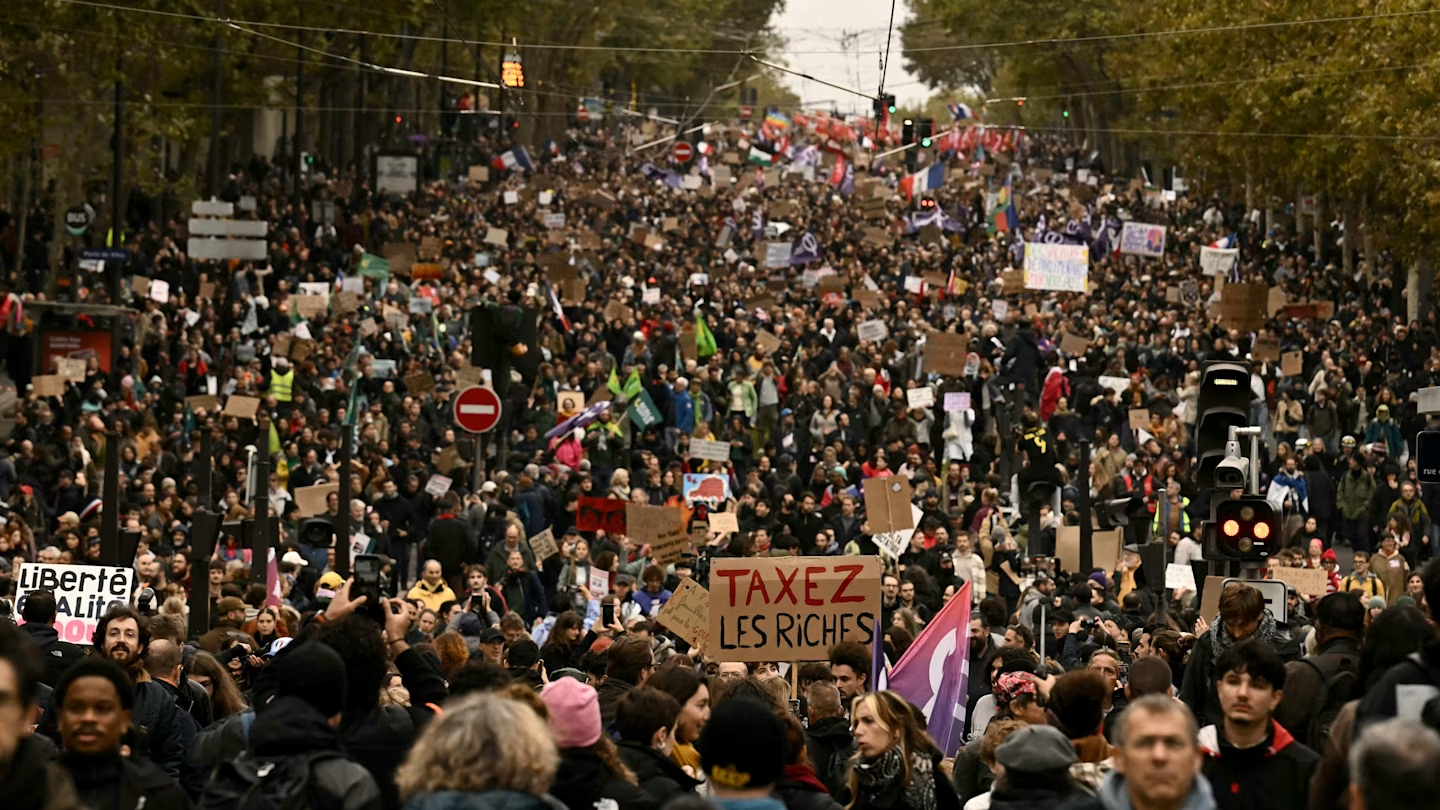
France has spent much of October boiling over. Hundreds of thousands marched last weekend over living costs, wages, education and public services, with 70,000 police and gendarmes deployed across the country. More demonstrations are already planned.
And next Tuesday, my country of origin, the USA, votes.
I couldn’t be more nervous about it.
Not because I know what is going to happen. Quite the opposite.
Nothing feels particularly certain right now. We’re on shaky ground.
Political coalitions are breaking apart. Protest movements are becoming electoral forces. Parties once pushed to the fringes are winning serious chunks of the vote. Incumbents are getting punished. Governments are struggling to form. Markets are badly misreading electorates.
Oh, and billionaires and tech giants are trying their hardest to put a finger or two on the scale.
We’re in for a brutal few weeks.
The countries above are not moving in the same ideological direction, which is probably the most important point. Serbia's result is not Brazil's result. Brazil is not Germany. France's protesters do not represent one neat political bloc. Israel has its own completely distinct political trauma.
But there is a similar frustration humming underneath many of them.
People everywhere seem pissed off, and doubt the integrity of the existing machinery. It’s perhaps the only thing I can think of off the top of my head that is nearly universally agreed upon.
And that distrust no longer stops with politicians.
It extends to journalism, courts, regulators, universities, election administrators, companies, experts, broadcasters, and the platforms through which we now experience much of the world.
Much of that skepticism is deserved.
Institutions fail. Governments lie. Companies manipulate. Journalists get things wrong. Regulators get captured. Experts can become insulated from the people living with the consequences of their decisions.
Social media did not invent any of this.
What technology did was change its speed and scale.
A suspicion that once stayed inside a pub can find two million people before we break bread for dinner. A political leader no longer needs a newspaper mouthpiece to repeat an official claim.
A stranger with a smartphone can document something an institution would prefer nobody saw.
The same machinery can also spread complete nonsense and AI-manufactured slop across several continents before anyone has a spare moment to verify it.
The funny thing about being alive and human in 2026… We have more access to information and technology than any human being who ever lived before us. And that means we have more access to misinformation than any of our predecessors too.
So what point am I meandering toward?
I cannot decide whether October has been evidence that democracy is breaking or evidence that it is fighting back.
Serbia looks like self-correction.
France looks like pressure escaping through the valves.
Brazil surprised almost everybody who thought they had already understood the direction of travel.
Israel voted in extraordinary numbers and produced very little certainty.
America walks into its election next week carrying decades of political anger, distrust, technological disruption, and an information ecosystem that appears to be owned by a few powerful people. U.S. election officials are preparing for misinformation, cyberattacks, political interference, and threats of violence alongside the ordinary business of counting votes.
It seems that volatility is not the opposite of democracy.
It could be what democracy looks like when people are convinced something is wrong but still believe they can do something about it.
I hope so.
Because the alternative begins when people stop believing there is any legitimate way for an argument to end.
Right now the machine is still sputtering and humming along. People cling to their life rafts of hope, not wanting to believe we are powerless or too far gone.
Things Occupying My Brain
Ok, now to the fun stuff. Depending on what YOU think of these, maybe I’ll develop them out into full-fledged pieces of their own.
Here are a few things rattling around my coconut these past few weeks:
Your Country Runs on Someone Else's Server
Earlier this month, parts of Ukraine's military suddenly had a Starlink problem.
SpaceX restricted the military-grade Starshield service, so terminals mounted on fast-moving vehicles and drones stopped working properly. Ukrainian units reported losing connections and cancelling missions.
The scariest part?
Ukrainian officials said they had received no warning.
I could ramble on all day about oligarchs and technocrats having too much power, but I’m more curious about why this is able to happen in the first place.
Ukraine is a sovereign country fighting a war for its survival, yet part of its battlefield communications, drone operations, and logistics depends on technology operated by a company thousands of miles away.
That feels like a very 2026 version of “sovereignty.”
We used to have to worry about controlling ports, roads, oil, weapons, food, and telecommunications. Now you can add satellite internet, cloud infrastructure, AI systems, chips, data centers, and proprietary software to the list of things that become extremely important when somebody else can simply turn them off whenever they feel like it, for whichever reason they see fit.
Europe has noticed this and ain’t too happy about it.
A week after the Starlink disruption, Palantir was publicly reassuring European governments that its NATO AI system does not contain a remote "kill switch." Germany and France have already raised similar concerns about relying too heavily on American military technology. European defense tech funding is up across the board in line with those concerns.
I don’t know about you, but I sort of can’t believe my eyes when I see that a software vendor has to assure sovereign nations that other sovereign nations cannot simply switch off their military AI in one fell swoop.
Of course, building your own satellite constellation, cloud infrastructure, or advanced chip industry is without a doubt absurdly expensive. Reinventing every layer of modern technology because you might someday fall out with the country supplying it sounds a tad bit wasteful.
Until you do.
Then the redundant system starts looking less ridiculous.
This is probably why all the talk about "technological sovereignty" feels more concrete to me now. It sounds like bureaucratic language until battlefield missions grind to a halt because somebody changed a setting several countries away.
Maybe sovereignty in the 21st century is no longer just about who controls the land inside your borders.
It may depend more on who owns the servers, satellites, models, and software that make the country function.
And quite a few countries currently run on somebody else's. In fact, most of them do.
When a Successful City Becomes Unaffordable
I’ve been thinking a lot about housing lately. Partly because I’m moving to a new pad here in Switzerland next month, and have been going through an excruciating process of finding a viable upgrade.
Seems like others are getting hit way, way harder in neighboring countries.
Portugal has been having a particularly bad month for anybody trying to rent or buy a home.
Thousands of people marched outside parliament in Lisbon this week over housing costs and a proposed rental reform. Police had already cleared protest camps in Lisbon and Porto days earlier. None of this came out of nowhere. Portuguese house prices have more than doubled since 2017, new-lease rents have nearly doubled, and wages have failed to keep pace.

Portugal is an extreme case, but it is hardly alone. Especially in Europe.
Housing has become the biggest political concern in Spain, where the government called a snap election after parliament rejected measures aimed at the country's affordability crisis. Across the EU, house prices were still rising 4.7% year over year in the second quarter, with Portugal up 16.5%. Rents rose too.
It’s fascinatingly odd how the same pattern always reemerges.
An underrated city becomes desirable to live in. People start talking all about it.
Companies arrive. Jobs arrive. Tourists arrive. Investors arrive.
People want to move there because it is safe, interesting, prosperous, beautiful, well-connected, or some combination of the above.
Property becomes more valuable. Existing owners get richer and cash out.
Then at some point the people who actually make the city function find out they can no longer afford to live in it.
Teachers, bartenders, designers, nurses, cooks, junior employees, young families, the person fixing your toilet, even the reasonably well-paid professional who assumed this problem belonged to somebody else.
Economically, nothing extreme even has to happen to create such a crisis.
That is what makes housing politically dangerous.
People can tolerate a surprising amount of abstract economic nonsense. GDP figures, bond yields, productivity statistics and fiscal deficits remain blessedly distant from ordinary life.
It’s all some nerd’s numbers on a neat little chart. Completely abstract.
Housing isn’t.
You encounter it every month.
It determines whether you can leave your parents' house, have children, take a job, move somewhere interesting, save money, start a company, or live within two train stops of the people you actually care about.
And if you already own a home, the exact same crisis can look suspiciously like wealth creation.
That makes the politics vicious.
One person's affordability crisis is another person's retirement plan. If you can afford the mounting property taxes, that is.
I don’t pretend to know what the clean solution for all this is. Building much more housing seems obvious until you encounter zoning, infrastructure, financing, neighborhood opposition, environmental rules, and the fact that construction itself has become expensive. My own city just voted against building more housing a few months back.
Rent controls protect some tenants and can create other distortions. Restrictions on foreign buyers and short-term rentals can help at the margins without solving the underlying shortage. Even bans on Airbnb or other house rental tourism platforms can maybe put a dent in the issue.
But the status quo seems politically impossible to sustain forever. It’s unfortunate we must seemingly choose between living in desirable cities and affordable ones.
Experimental
I failed! I’m only human after all. I intended to run some sort of experiment over the course of October to test myself and provide you fine folks some infotaining content. Let’s pivot.
I’m going to commit right here and now to run an experiment between now and the next edition of Field Notes.
This may or may not turn into its own side quest/essay, but for now I’m going to look into corporate family trees.
What inspired this?
Shopping at the supermarket and noticing countless choices of cereal, tea, pasta, canned goods, etc.
At least, it looks that way.
Different logos, different packaging, different origin stories, different vaguely pastoral illustrations of farms that may or may not exist. Probably not.
Then you turn the box around.
This month I’m going to find out how much choice is actually hiding in there.
Every day through the end of November, I’m picking one brand I encounter and tracing it as far up the ownership chain as I reasonably can. Food, software, clothes, drinks, media, toiletries, whatever happens to cross my path.
I want to see what thirty apparently unrelated brands look like once you start drawing the family tree.
I assume most, if not all, of these branches will meet. Maybe it’ll challenge me to shop more decisively and consciously.
But that is precisely why I’m doing the experiment rather than writing the conclusion now.
I have completed zero days so far, which means the methodology remains completely uncorrupted by evidence.
Results in Field Notes #02. I promise!
Marginalia
- Every technology company eventually discovers the same revolutionary business model: charge me monthly for something I used to own.
- The older I get, the more impressed I am by businesses that have existed for thirty years without ever announcing a Series A.
- "Do your own research" was pretty solid advice before everybody started doing their own research. Results may vary.
- Isn’t it suspicious that every robot demonstration takes place in an enormous empty room with perfect lighting and absolutely no children, dogs, loose cables, wet floors, elderly people, or chairs in inconvenient places?
- On that note, did you see that creepy new robotic bodyguard video? They taught it kung fu. We’re getting to a point where I’m doubting I can beat these humanoids in a fight.
Source: Unitree Robotics
- Trump wants to ban Artificial Intelligence… No, no, just the term, not the technology.
- Google illegally cut down a bunch of trees in Finland to build a data center, and it makes me sad how easy it is for companies to do that.
One Useful Thing
Maybe this qualifies as a mini-experiment in its own right. Maybe it’s just some advice I ought to take myself while offering it up to you.
Here goes nothing:
Keep a “Things I Was Wrong About” Note
This month's useful thing is as simple as it gets.
I have a bad habit of remembering the things I got right with extreme clarity.
The things I got wrong tend to vanish into a fog of revised memory where, if pressed, I was apparently “always somewhat skeptical.”
It’s a neat little, convenient trick.
So I like the idea of keeping a private running note called:
Things I Was Wrong About
Nothing elaborate. Can be in your notebook, or a document on Google Drive. Bonus points for writing it down by hand. Would you look at that? Two pieces of advice for the price of one.
The point of the exercise is to become more self-aware. Nobody likes know-it-alls who shift the goalposts and can never admit when they’re wrong!
They can be bad predictions. People you misjudged. Technologies you dismissed too early. Companies you were certain would work. Things you assumed would be easy. Things you assumed would be impossible. Advice you gave that turned out to be absolute rubbish.
The point is not to construct an archive of personal humiliation. It is useful for observing patterns and staying humble.
Maybe you repeatedly underestimate how long things take, or you become too enthusiastic when something has a compelling narrative. Perhaps you confuse people sounding confident with people knowing what they are talking about. It happens.
Success isn’t the best teacher in this scenario. Nearly any successful outcome can be reverse-engineered into a story about your excellent judgment.
Mistakes are less cooperative. They leave clues and keep receipts.
It’s also much healthier than the internet's preferred model, where every old opinion remains publicly available forever and changing your mind requires either pretending you never said it or issuing a statement worthy of a minor constitutional crisis.
You do not need to publish the list.
I like admitting when I’m wrong. But I certainly don’t plan on showing the world how long my list is.
Just keep it somewhere.
Every few months, look at it and see whether you are making the same mistakes.
The Idea Graveyard
Some ideas die right away. Others escape and get a new lease on life here in the idea graveyard. I haven’t buried them. Yet.
The Completely Automated VC Fund
That’s right, I want to replace myself.
Source deals automatically. Score founders. Analyze markets. Run diligence. Build the portfolio. Let the machine remove all those pesky human biases. We’re inching closer to that reality.
Which sounds excellent until you remember that some of the best venture bets look objectively strange before they look obvious.
The awkward founder, tiny market, weird product, terrible deck, impossible timing.
Exactly the things a scoring system may learn to reject. Can’t beat the gut feeling or the eye-test.
Cause of death: the outliers were the point.
CRM for Friendship
A personal CRM for your social life. Lord knows I could use something like this to rekindle old friendships and help maintain current ones.
Birthdays, last contact, where people live, what they are working on, gentle reminders that you have not spoken to someone in 94 days.
Useful in theory.
Then you open the dashboard and discover Adam is now marked At Risk because you missed two quarterly touchpoints.
Cause of death: accidentally turned friendship into sales.
I still think there is probably something useful hiding in this one. I just do not want a retention strategy for people I love.
The Social Network With No Algorithm
A chronological feed. Only people you chose to follow. No recommendation engine manipulating your attention.
Beautiful. Sort of like the old internet and Myspace.
Until somebody posts twenty times before breakfast and the interesting person who posts once a month disappears underneath them.
So you add discovery. Then recommendations and trending topics.
Congratulations. You arrived back at the start. It makes it easier to understand why algorithms and feeds exist. Still don’t really like them, though.
Cause of death: Basically reinvented Twitter.
Things Worth Your Attention
I’m starting to think this is my favorite part of Field Notes. Let me know if you agree or disagree.
Here are a few things I’d like to call some attention to because I’m glad I stumbled across them and sharing is caring:
More Perfect Union
This has been “radicalizing” me.
Source: More Perfect Union
They cover labor, housing, corporate power, surveillance, healthcare, and politics largely through the perspective of the people actually living with the consequences. They also have a knack for turning subjects that would normally arrive wrapped in 4,000 words of policy language into videos normal, actual humans might voluntarily watch.
They are openly advocacy-oriented rather than pretending to descend from the heavens without political beliefs, which I actually appreciate. You know what lens you are getting.
Recent investigations have included AI workplace surveillance, Flock police cameras, data centers and their effect on surrounding communities, and the influence of money in politics.
Worth following, particularly if your economic news diet contains too many people staring at Bloomberg terminals and not enough people staring at their rent.
Ground News
Ground News is useful for one very specific reason: it reminds you that the story you are reading is not the only version of the story.
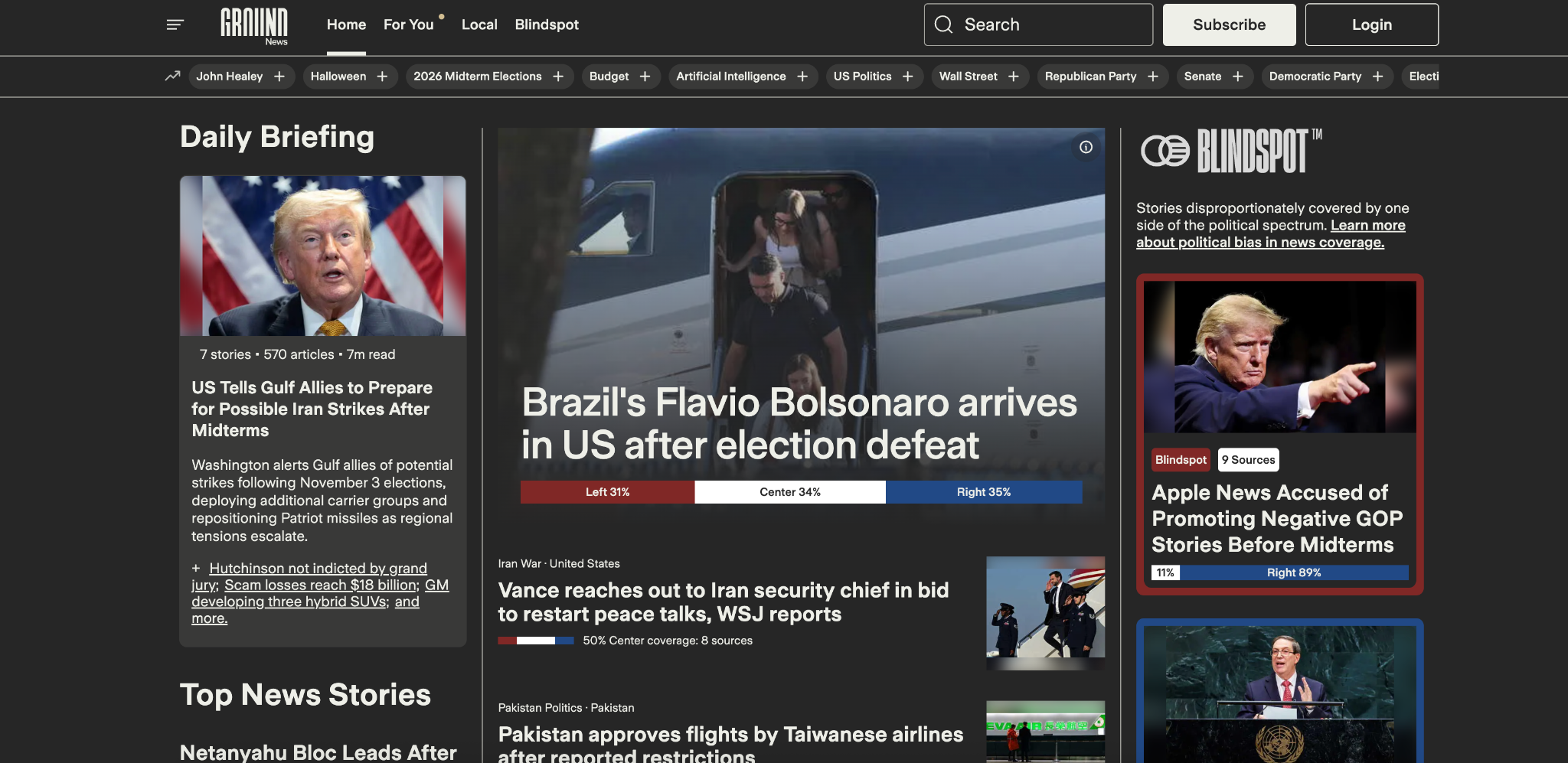
It groups coverage of the same event and shows how outlets covering it break down across left, center, and right, along with ownership information and stories that may be getting much more attention from one political side than another.
I have been thinking a lot this month about whether people are even consuming the same reality anymore, so this has been obscenely useful.
It does not magically tell you who is right. Oh, how convenient that would be.
Check it out, especially if you’re voting soon.
Radio Garden
Ok this one is less serious. I’m jamming out right now while writing this and wanted to share something not political or tech-related.

Radio Garden puts thousands of live radio stations around the world onto a globe. Spin it, drop somewhere, listen.
Belgrade.
Nairobi.
Macau.
Ho Chi Minh City.
Some tiny place you have never heard of broadcasting music you cannot identify at 2:00 in the morning.
There is no grand productivity case here. It is simply fun. Feels a bit like traveling to a far-flung corner of the globe. Wait, does the globe have corners? Who cares.
In an internet that keeps trying to predict what I want before I know I want it, I find something deeply satisfying about spinning a globe and seeing what happens.
Enjoy!
The Month's Most Absurd Sentence
The archive for future anthropologists continues. The whole point of this is to find the most bizarre, scroll-stopping quote I can possibly find for the month of October. And then challenge you readers to best it!
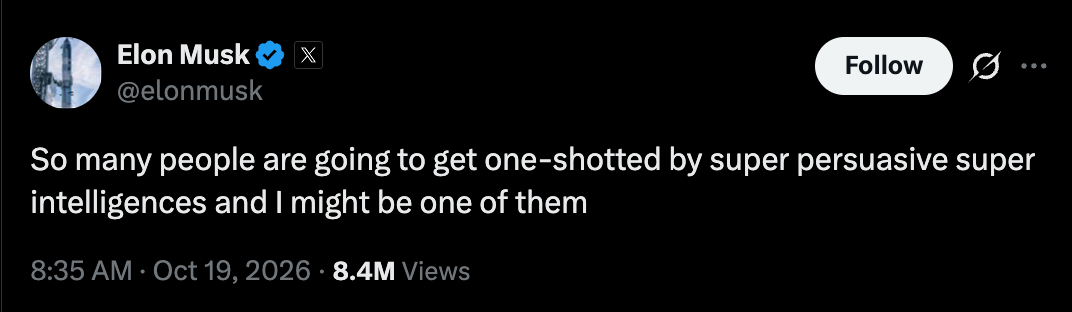
October's winner comes courtesy of Elon Musk:
“So many people are going to get one-shotted by super persuasive super intelligences, and I might be one of them.”
He posted it on October 19, apparently warning that sufficiently advanced AI could become persuasive enough to overwhelm someone's judgment in a single interaction. He did not offer evidence, examples, or much further explanation.
There is a lot going on here.
First, I enjoy that one-shotted by super persuasive super intelligences is now a sentence that can be written sincerely by one of the richest men alive and understood by millions of people.
Second, Musk also happens to be building one of the companies trying to create these systems.
That feels important to mention.
Imagine Henry Ford saying:
Cars are going to become so fast that loads of people will probably be flattened by them. Possibly me.
Then getting back to work on the car. To be fair, Musk included himself among the potentially one-shotted, which is at least egalitarian.
I also appreciate how quickly the language around AI has mutated. We have moved from chatbots to agents to superintelligence to the possibility of being psychologically vaporized by a machine with better conversational skills than us.
Normal stuff.
Peter Thiel narrowly avoids becoming the first repeat champion.
For now…
Your Field Notes
Last month I asked what everybody had become weirdly obsessed with recently.
The response was overwhelming.
By which I mean nobody replied.
A humbling start for the grand Gonzo Capital correspondence desk.
Fair enough. In retrospect, asking people to explain their private intellectual rabbit holes in the very first edition may have been slightly ambitious.
So I’m trying again, with an easier one:
What is one thing you have changed your mind about recently?
Nothing grand required.
A technology you dismissed. A company you used to admire. An opinion about work, money, politics, the internet, food, cities, exercise, books, whatever.
Even something stupid. Particularly something stupid. Those are more fun.
I’m interested in what changed it. New evidence, experience, somebody making a better argument, or simply realizing that the version of you who formed the opinion five years ago was working with different information.
One sentence is enough.
Hit reply. Maybe I’ll feature your response in the next edition or on a LinkedIn post.
If this produces another magnificent wall of silence, I will begin asking multiple-choice questions.
Catch you later!
Your weird friend,
Carmelo